


Global infrastructure projects—high-speed rail, modern airports, and large water systems—are driving new demands for concrete. Materials should deliver high strength, durability, and adaptability while supporting efficient construction and long-term performance.
To meet these challenges, the concrete industry is advancing with high-performance mix designs, smart construction technologies, and sustainable solutions. Innovative and eco-friendly concrete is now essential for global projects, ensuring safety, resilience, and efficiency across diverse engineering applications.
Concrete Requirements for High-Speed Rail Projects
High-speed rail projects worldwide—from Europe’s TGV and Japan’s Shinkansen to emerging networks in Asia and the Middle East—require concrete with exceptional performance and durability. Bridges, tunnels, and track foundations should withstand high-speed operations and repeated dynamic loads, making material quality a critical factor for long-term structural stability.
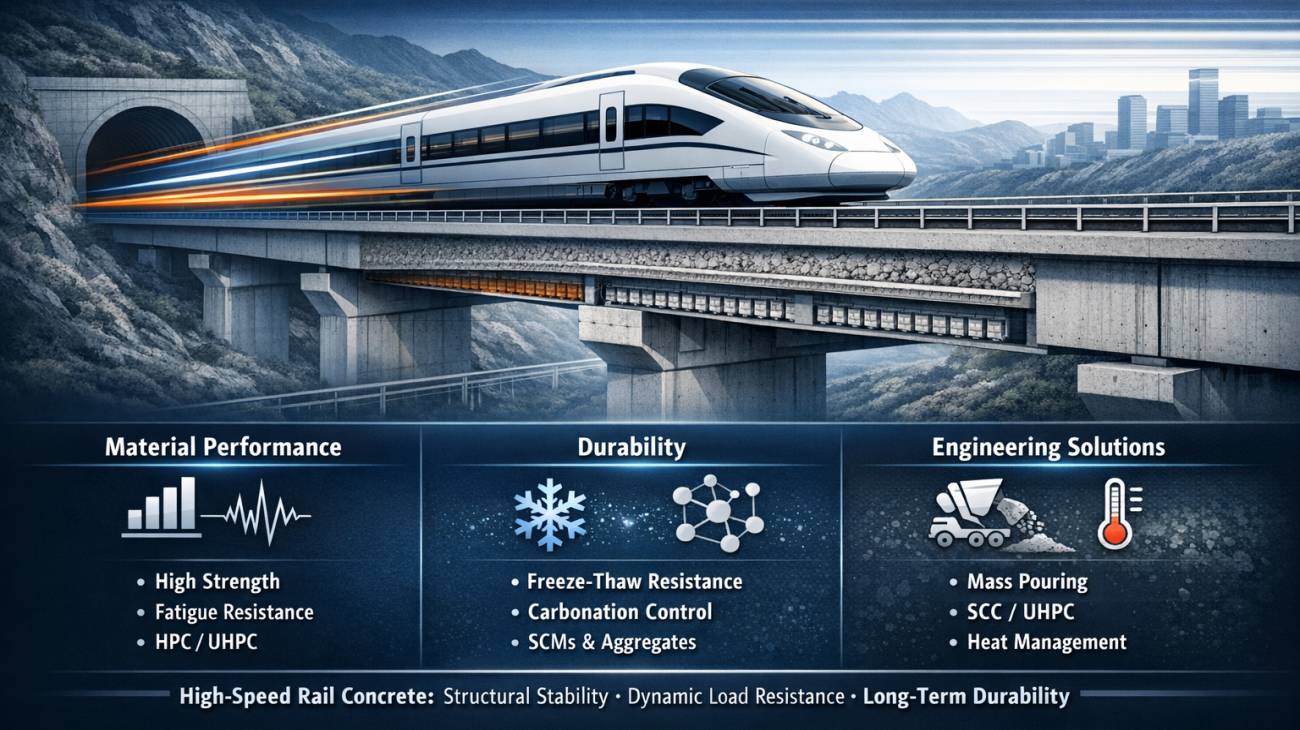
Material PerformanceConcrete for high-speed rail should deliver high strength, toughness, fatigue resistance, and vibration resistance. High-performance concrete (HPC) is widely used to meet these demands, ensuring structural stability under constant train traffic and minimizing long-term maintenance needs.
Durability RequirementsDurability is essential for safety and longevity. Concrete must resist freeze-thaw cycles, wear, and carbonation, which can degrade structural integrity over time. Advanced mix designs, supplementary cementitious materials, and carefully selected aggregates enhance lifespan while maintaining consistent quality in different environmental conditions.
Key Engineering ChallengesLarge-volume pours in bridges and tunnels present challenges such as workability, heat of hydration management, and uniform curing. Consistent mix quality from ready mix concrete plants is crucial. Innovative solutions like self-compacting concrete (SCC) and ultra-high-performance concrete (UHPC) are increasingly adopted to meet complex geometries and high-performance requirements.
By addressing these material, durability, and engineering challenges, concrete used in high-speed rail ensures safety, structural stability, and operational efficiency for decades, meeting the rigorous standards of modern rail infrastructure.
Concrete Requirements for Airports
Airports around the world require concrete that can withstand heavy aircraft loads, frequent traffic, and fluctuating environmental conditions. Critical surfaces—including runways, taxiways, aprons, and terminal foundations—demand carefully designed materials to ensure durability, strength, and long-term operational reliability.

Material Design Considerations
Concrete used in airport infrastructure should provide crack resistance, early strength, wear resistance, and smooth surface finish. Early-strength concrete allows faster construction and minimizes disruptions to airport operations, while wear-resistant mixes ensure long-term durability under continuous aircraft traffic. Surface smoothness is essential for safe takeoffs and landings, making precise mix proportioning and quality control crucial.
Functional Performance
Airport concrete needs to perform under extreme temperature variations, heavy wheel loads, and repeated stress cycles. Advanced admixtures and fiber reinforcement enhance tensile strength, reduce micro-cracking, and improve resilience over time. These high-performance concrete formulations maintain consistent functional performance across decades of service, ensuring operational safety and reliability.
Sustainability Trends in Global Airport Construction
International airport projects increasingly integrate sustainable concrete solutions, such as recycled aggregates, low-carbon cement, and environmentally friendly admixtures. Ready mix batching plants supplying these projects play a key role in maintaining consistent quality while supporting eco-friendly materials. Adoption of sustainable practices not only meets global regulatory standards but also reduces long-term environmental impact.
By optimizing material composition, performance characteristics, and sustainability factors, engineers and suppliers can provide airport-specific concrete solutions that ensure safety, operational reliability, and long-term durability.
Concrete Requirements for Water Infrastructure
Water infrastructure projects—such as dams, reservoirs, levees, and irrigation facilities—pose unique challenges due to constant exposure to water, hydrostatic pressure, and chemical interaction. The following key aspects define the concrete requirements for these projects:
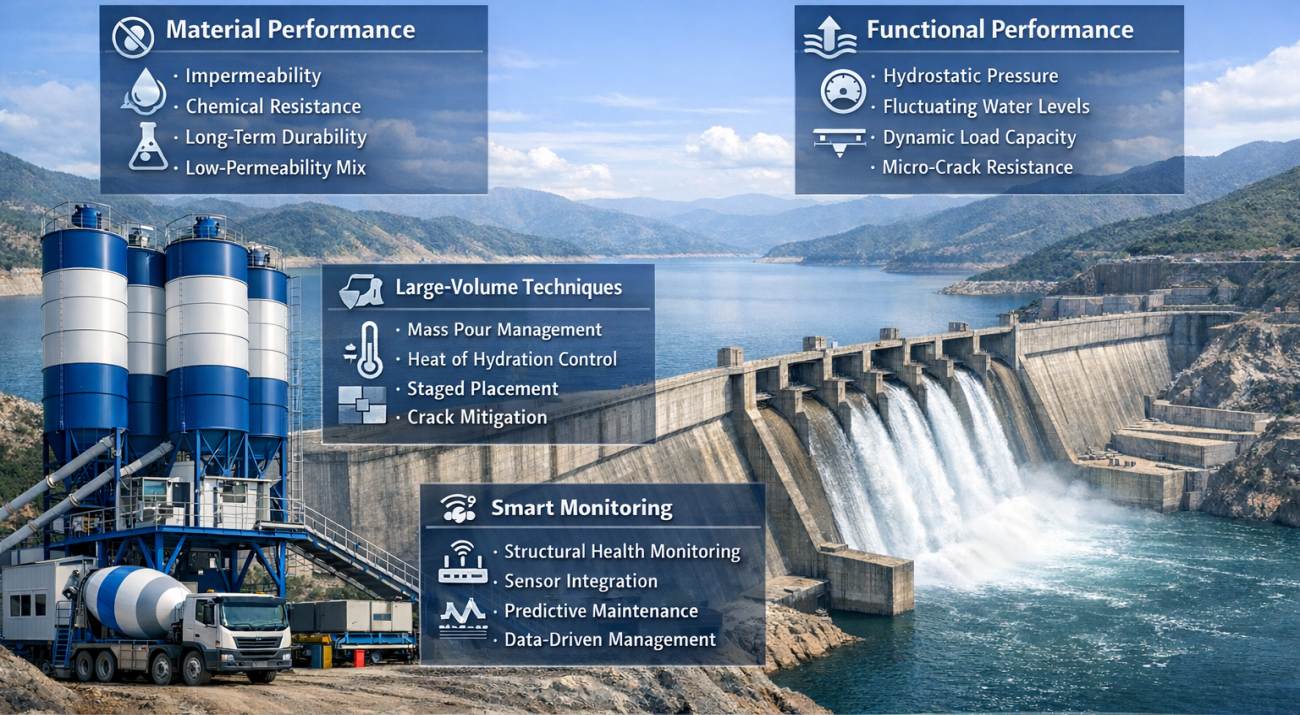
Material Performance and Durability
- Concrete in water infrastructure is designed to provide impermeability, preventing leaks and seepage under continuous water exposure.
- It is formulated to resist chemical attack from minerals, sediments, and potential pollutants present in water environments.
- Long-term durability is essential, allowing the concrete to withstand abrasion, flow erosion, and environmental wear over several decades.
- The use of low-permeability concrete, supplementary cementitious materials, and chemical-resistant admixtures helps ensure structural integrity and prolonged service life.
Large-Volume Concrete Techniques
- Massive pours are common in dams, reservoirs, and levees, requiring careful management of heat of hydration.
- Techniques such as staged pouring, thermal control, and shrinkage-reducing admixtures reduce cracking risk and enhance long-term stability.
- Proper planning ensures uniform curing and consistent quality across large structures.
Functional Performance in Water Environments
- Concrete is designed to tolerate fluctuating water levels, hydrostatic pressure, and temperature variations.
- Enhanced tensile and compressive properties help ensure structural reliability under dynamic water loads.
- Resistance to micro-cracking and deformation is essential for maintaining long-term safety and functional performance.
Smart Monitoring and Lifespan Management
- Integration of sensor-based structural health monitoring systems enables real-time tracking of stress, temperature, and water penetration.
- Predictive maintenance and data-driven decision-making extend the service life of concrete structures.
- Supports global trends in sustainable concrete solutions and efficient infrastructure management.
Through the integration of advanced materials, efficient large-volume construction methods, functional adaptability, and smart monitoring systems, suppliers can deliver durable, resilient, and sustainable concrete solutions for modern water infrastructure.
Concrete Material Innovation and New Mix Designs
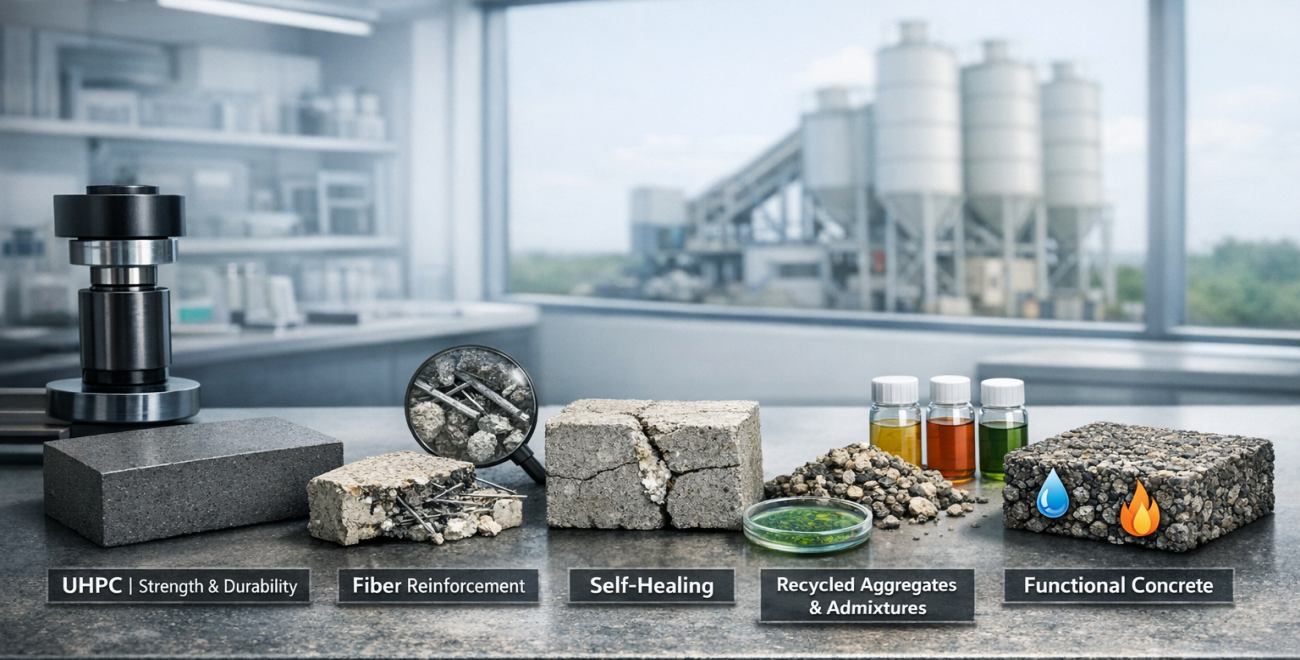
Modern infrastructure projects increasingly demand advanced concrete materials that provide superior performance, durability, and functionality. Material innovation and new mix designs are central to meeting these global challenges. Key innovations include:
Ultra-High-Performance Concrete (UHPC)
- UHPC offers exceptional compressive and tensile strength, making it ideal for bridges, high-speed rail, airport pavements, and water structures.
- Its dense microstructure enhances durability, crack resistance, and fatigue performance, reducing maintenance needs over time.
- UHPC supports slimmer structural designs and longer spans, contributing to material efficiency and sustainability.
Fiber-Reinforced Concrete (FRC)
- Incorporates fibers such as steel, glass, or synthetic fibers to improve tensile strength, ductility, and impact resistance.
- Reduces the risk of micro-cracking and spalling in high-load or dynamic applications.
- FRC enhances durability under freeze-thaw cycles, heavy traffic, and vibration, making it suitable for railways, airports, and hydraulic structures.
Self-Healing Concrete
- Designed to autonomously repair cracks using embedded microcapsules or bacterial agents.
- Extends service life and reduces maintenance costs, particularly in large-scale and hard-to-access infrastructure.
- Supports sustainable practices by minimizing repair materials and downtime.
Innovative Admixtures and Recycled Aggregates
- Use of chemical admixtures enhances workability, early strength, shrinkage control, and durability.
- Incorporation of recycled aggregates promotes sustainability, reduces environmental impact, and aligns with low-carbon construction trends.
- Optimized mixes balance performance, cost, and ecological considerations.
Functional Concrete
- Pervious concrete improves stormwater management and reduces surface runoff.
- Thermal-resistant concrete enhances heat tolerance for pavements and industrial applications.
- Antimicrobial or fire-resistant mixes provide added safety and environmental benefits.
Value of Material Innovation
- Advanced concrete materials enable high-performance concrete solutions for complex infrastructure projects.
- Innovations enhance structural resilience, longevity, and adaptability, supporting international standards for safety and sustainability.
- Facilitates ready mix concrete plants to produce consistent, high-quality mixes for diverse applications worldwide.
By using advanced concrete technologies such as UHPC, FRC, self-healing concrete, and recycled aggregates, industry professionals can create durable, high-performance, and sustainable solutions. These technologies help meet modern infrastructure needs while lowering costs and reducing environmental impact.
Global Concrete Technology Upgrades for Modern Infrastructure
Modern infrastructure projects (high-speed rails, airport and water infrastructure) demand more than advanced concrete materials; they require reliable production systems, precise execution, and intelligent construction processes. Across global markets, concrete technology upgrades are increasingly focused on how concrete is produced, managed, and delivered at scale, ensuring consistent performance for complex and long-life infrastructure.
01Scalable Application of High-Performance Concrete
In modern infrastructure, the challenge is no longer developing high-performance concrete, but applying it consistently across large and complex projects. Technology upgrades now emphasize:
- Automated batching and weighing systems
- Centralized quality control across multiple production lines
- Stable performance during long-distance transport and pumping
Advanced ready mix plants play a central role by integrating digital control systems that ensure accuracy, repeatability, and traceability. This allows high-performance concrete to be deployed reliably in bridges, transport hubs, and water resources projects worldwide.
02Smart Construction and Real-Time Monitoring
Smart construction technologies are redefining quality control and risk management in concrete works:
- Embedded sensors monitor temperature development, stress, and curing conditions
- Digital dashboards provide real-time visibility into construction performance
- Early-warning systems help identify potential issues before structural risks emerge
These technologies reduce reliance on manual inspection and support data-driven decision-making, especially critical for large-scale infrastructure with long construction cycles.
03Process Efficiency and Construction Optimization
Concrete technology upgrades also focus on improving construction efficiency and predictability:
- Self-compacting concrete reduces placement complexity and labor intensity
- Early-strength concrete shortens construction cycles and accelerates project delivery
- Automated pumping and placement systems improve accuracy while minimizing material waste
In parallel, modular and prefabricated construction approaches allow concrete elements to be produced under controlled conditions, enhancing quality consistency and onsite efficiency.
04Evolution of Ready Mix Batching Plant Operations
Modern ready mix concrete batching plants are evolving from basic production facilities into intelligent infrastructure-support systems:
- Digital dispatch and logistics optimization improve supply reliability
- Remote monitoring enables centralized management of multiple plants
- Integrated data systems support standardized production for international projects
These innovations strengthen the ability of concrete suppliers to support diverse infrastructure demands while maintaining efficiency, consistency, and compliance with global standards.
Why Technology Upgrades Matter
Technology upgrades in production systems, construction methods, and digital management tools enable the concrete industry to move beyond material capability toward execution excellence. These advancements improve reliability, efficiency, and long-term performance, helping modern infrastructure projects meet the evolving demands of global transportation, energy, and water systems.
Sustainability and Green Concrete: Environmental Drivers and Industry Direction

Global Policies Driving Low-Carbon Transformation
Sustainability has become a strategic factor in global infrastructure. Governments and international organizations are setting carbon reduction targets, green procurement standards, and emissions reporting requirements, making sustainable concrete a necessary consideration in large projects.

Industry Shift Toward Green Practices
Concrete producers and contractors are adopting process improvements and sustainable practices to lower emissions while maintaining structural reliability. This includes optimizing production, using recycled materials, and improving waste management, reflecting a broader commitment to environmental responsibility.

Lifecycle Assessment and Carbon Management
Lifecycle assessment (LCA) evaluates environmental performance from production to long-term operation. By tracking carbon footprints and optimizing design for durability, stakeholders can reduce maintenance needs and extend service life, supporting sustainability goals.

Global Infrastructure Applications
Sustainability is shaping projects worldwide, including railways, airports, and water infrastructure. Integrating policies, operational improvements, and environmental metrics allows large-scale projects to meet both performance and environmental objectives.

Strategic Direction
Green concrete is increasingly a baseline expectation for modern infrastructure. Aligning policy, industry practices, and lifecycle thinking ensures long-term reliability while advancing global sustainability goals.
Industry Strategies and Enterprise Responses
Corporate Strategy and Global Compliance
Global concrete producers and construction enterprises are aligning corporate strategies with international standards and sustainability requirements. Key initiatives include:
- R&D investment to explore low-carbon solutions, improve production efficiency, and support scalable infrastructure projects
- Equipment upgrades in concrete plants for consistent quality, higher output, and operational reliability
- Compliance with international standards, including ISO certifications and environmental regulations, to maintain competitiveness in global markets
These measures enable companies to proactively respond to regulatory pressures and evolving infrastructure demands worldwide.
Project Collaboration and Integration
Effective large-scale infrastructure delivery depends on close cooperation among contractors, concrete suppliers, and equipment manufacturers. Coordinated planning facilitates:
- Seamless integration of production, transport, and onsite placement
- Optimized resource allocation and reduced delays
- Alignment on quality, sustainability targets, and safety standards
This collaborative approach reduces risk, improves efficiency, and ensures project objectives are met.
Workforce Training and Certification
A skilled workforce is essential for implementing advanced concrete technologies and sustainable practices. Enterprises focus on:
- International certifications for plant operators, engineers, and site supervisors
- Continuous training on operational best practices, safety, and environmental compliance
- Knowledge sharing across project teams to maintain consistent quality globally
Strategic Impact on Market Adaptation
By integrating corporate strategy, project collaboration, and workforce development, the concrete industry strengthens its ability to adapt to global market trends, regulatory requirements, and technological advances. These strategies help enterprises deliver efficient, sustainable, and reliable infrastructure solutions, ensuring long-term competitiveness and resilience in the evolving global construction market.
Conclusion: Advancing Sustainable Concrete Infrastructure

The concrete industry is transforming to meet the rising demands for strength, durability, and sustainability in modern infrastructure. Innovative mix designs, advanced construction technologies, and eco-friendly solutions help create safer, more efficient, and resilient projects. By combining strategic planning, skilled execution, and workforce expertise, the industry delivers infrastructure that aligns with global standards.
Reliable equipment is key to these achievements. Contact AIMIX to discover high-performance concrete batching plants designed for efficiency, precision, and sustainability. Our team is ready to provide dependable solutions that support your construction goals.
