


The global road and bridge construction industry is a core part of transportation infrastructure, playing a strategic role in economic growth and regional connectivity. In 2025, the global market is valued at about USD 2.67 trillion and is expected to reach USD 3.67 trillion by 2030, with a CAGR of 6.5%. The bridge construction market is projected to grow at 4.2% annually from 2025 to 2033, reaching around USD 175.25 billion by 2033.
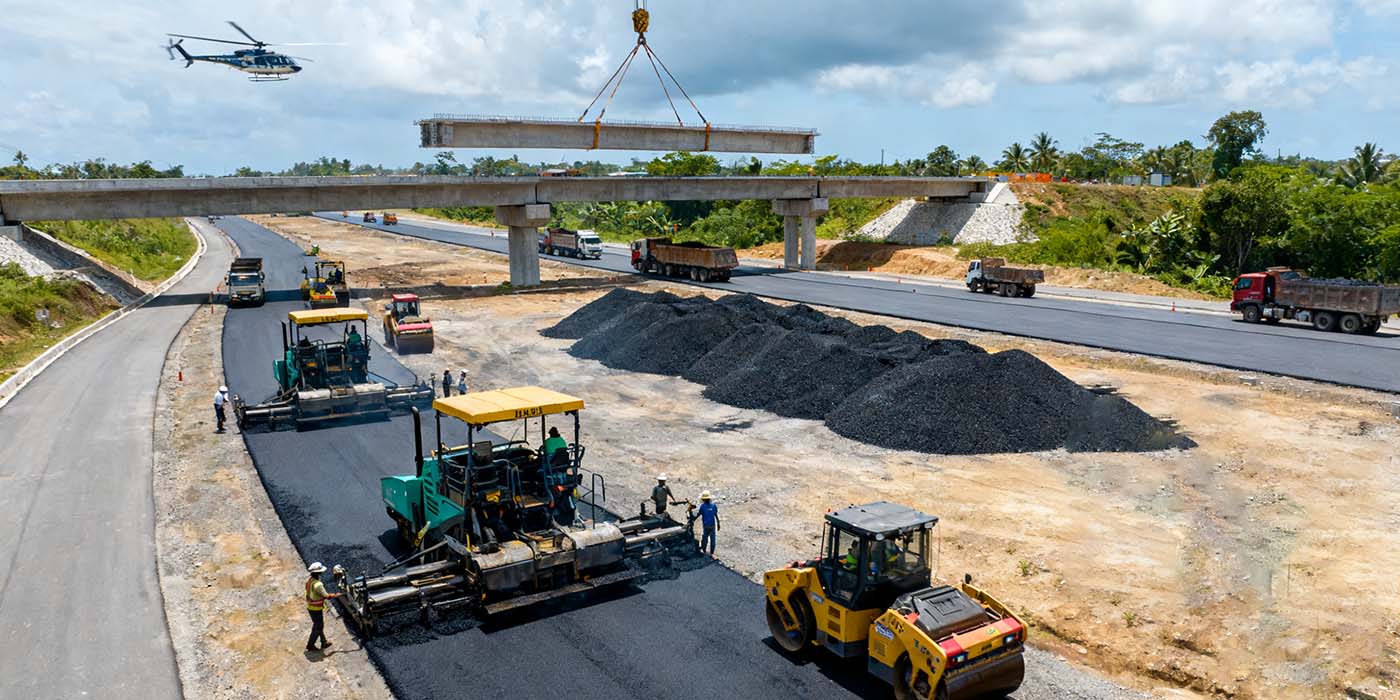
The Asia-Pacific region leads global growth, driven by population scale and urbanization. Governments are increasing infrastructure spending, while private capital and major contractors are more actively involved. At the same time, the industry is shifting toward digital, intelligent, and low-carbon construction, with modern technologies and equipment becoming key drivers. This white paper analyzes market trends, regional opportunities, competition, and technology directions to support policy, investment, and industry decisions.
Background and Strategic Importance of the Global Road and Bridge Construction Industry
The global road and bridge construction industry is a key foundation of economic development and urbanization, reflecting transport efficiency and national competitiveness. Driven by urban population growth, infrastructure expansion in emerging markets, and renewal of aging networks in developed countries, the market continues to expand. This chapter outlines the industry’s strategic importance from the perspectives of infrastructure investment, urbanization and transport modernization, technology and digitalization, and policy and international cooperation.

Long-Term Trends in Global Infrastructure Investment
Global infrastructure investment remains a key driver of growth, employment, and connectivity, especially amid urbanization and supply chain restructuring. Transport infrastructure accounts for 30%–40% of total spending, with roads and bridges as the largest share. Since the 2020s, investment has continued to expand, with widening regional gaps and more market-based financing, supporting stable demand for road and bridge construction.
Global Road and Bridge Construction Market Size and Growth Trends
| Global Road and Bridge Construction Market Forecast (2024–2030) | |||
|---|---|---|---|
| Year | Total Road/Street/Bridge Market (USD bn) | Bridge Market (USD bn) | CAGR |
| 2024 | 2,600 | 118.9 | — |
| 2025 | 2,750 | 125.0 | 5.5% |
| 2026 | 2,910 | 132.0 | 5.9% |
| 2028 | 3,230 | 150.0 | 5.8% |
| 2030 | 3,700 | 175.0 | 5.9% |
| Global Infrastructure Investment Scale and Growth | ||||
|---|---|---|---|---|
| Category | 2022 | 2024 | 2030 (Forecast) | CAGR |
| Road/Street/Bridge Construction | USD 1.8T | USD 2.6T | USD 3.7T | ~5.9% |
| Total Transport Infrastructure | ~USD 3.1T | USD 3.5T | ~USD 4.2T | ~5.5% |
| Bridge Construction Market | ~USD 105B | ~USD 119B | 175B+ | ~4.2% |
Linkage Between Public Investment and Economic Growth
Infrastructure investment is widely recognized as a fiscal tool with strong multiplier effects. Studies show that transport investment significantly supports GDP growth, job creation, and productivity, especially during economic downturns.
| Macroeconomic Effects of Transport Infrastructure Investment | ||
|---|---|---|
| Indicator | Typical Range | Description |
| Investment Multiplier | 1.5 – 2.5 | Each USD 1 generates USD 1.5–2.5 in GDP |
| Job Creation | 10,000–18,000 per USD 1B | Including direct and indirect employment |
| Logistics Cost Reduction | 5%–15% | Due to improved transport efficiency |
| Regional Investment Growth | +10%–30% | Near logistics and industrial hubs |
Key mechanisms include:
Short Termconstruction drives labor and material demand;
Medium Termimproved efficiency lowers business costs and boosts industrial clustering;
Long Termregional integration expands labor and capital mobility.
As a result, road and bridge projects are often prioritized in economic stimulus programs.
Investment Structure Differences Between Economies
Infrastructure investment structures vary significantly by development stage, directly affecting project types, scale, and equipment demand.
| Infrastructure Investment Structure by Economy Type | ||
|---|---|---|
| Dimension | Developed Economies | Emerging Economies |
| Focus | Maintenance, expansion, smart upgrades | New highways, network expansion |
| Project Types | Bridge reinforcement, road rehabilitation | New corridors, intercity highways |
| Investment Growth | 2%–4% per year | 6%–9% per year |
| Engineering Features | High standards, tight schedules | Large scale, fast rollout |
| Equipment Demand | High precision, low emissions, smart systems | High capacity, mobile, terrain-adaptive |
Implications: Emerging markets drive most new demand; Mature markets emphasize quality, sustainability, and smart construction; Contractors and equipment suppliers must adopt region-specific solutions. This dual structure of “new-build markets + upgrade markets” is expected to persist over the next decade.
Expansion of Private Capital and Diversified Financing
Traditional government-led investment models are shifting toward diversified financing. PPP, infrastructure funds, development bank financing, and capital market tools are playing larger roles.
| Financing Structure Trends in Road and Bridge Projects | |||
|---|---|---|---|
| Source | 2010s Share | Around 2025 | Key Features |
| Government Budgets | 60%–70% | 45%–55% | Declining due to fiscal pressure |
| PPP Models | 10%–15% | 20%–30% | Risk-sharing, efficiency driven |
| Multilateral Institutions | 8%–12% | 10%–15% | Focus on cross-border projects |
| Funds & Bonds | 5%–10% | 10%–20% | Faster growth in mature markets |
Impacts include: Greater focus on lifecycle returns and sustainability; Contractors need financing coordination and O&M capabilities; Equipment selection emphasizes energy efficiency and reliability. This accelerates the shift from single-project delivery to integrated invest–build–operate models.
Core Role of Road and Bridge Projects in Integrated Transport Systems
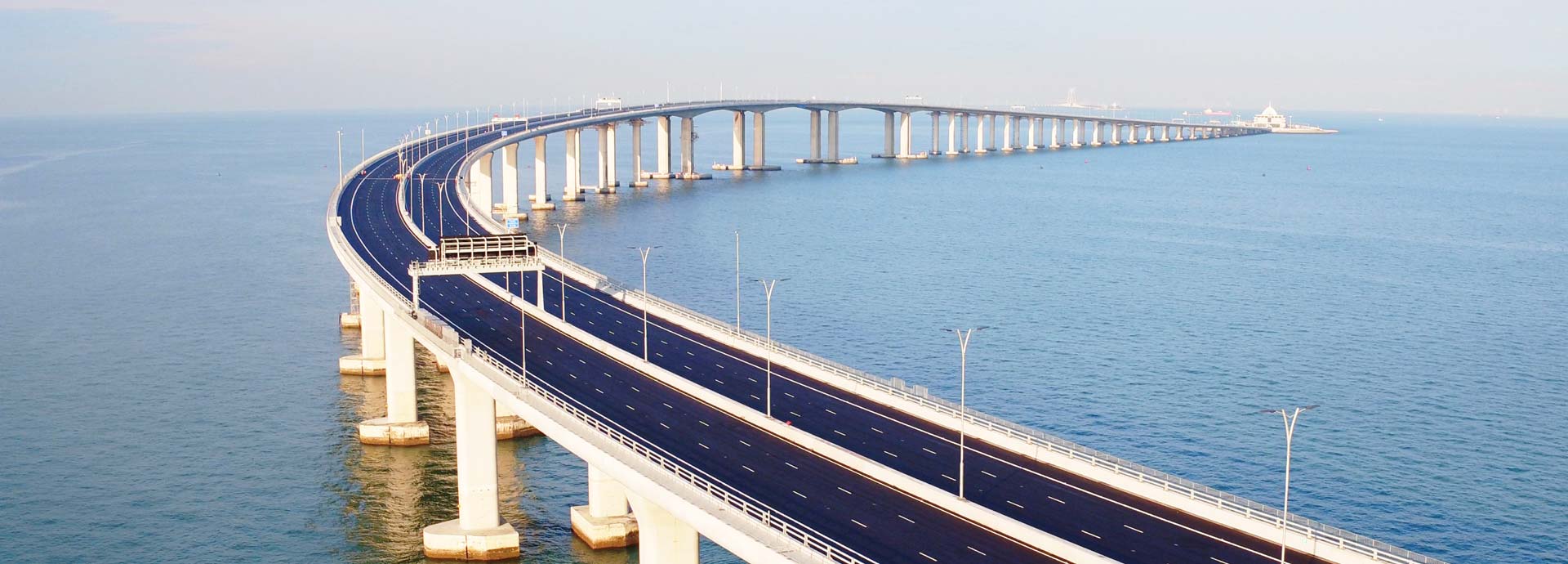
In modern transport systems, roads and bridges provide basic network coverage, last-mile access, and cross-regional connectivity. They link railways, ports, airports, and urban transit into one system. Compared with rail and air transport, road networks offer wider coverage and greater flexibility. They remain essential for daily travel, freight movement, and emergency response, and often serve as the first step toward transport modernization in developing and integrating regions.
Road Networks as the Foundation of Regional Connectivity
Road networks determine how easily people, goods, and industries move within and across regions. They form the basic condition for industrial layout and urban development. Many economic geography studies show a strong link between transport accessibility and regional growth.
| Typical Economic Impacts of Improved Road Networks | ||
|---|---|---|
| Impact Area | Quantified Effect | Description |
| Regional GDP Growth | +1.0%–2.5% per year | Within 3–5 years after highway access |
| Manufacturing Investment | +15%–40% | After logistics costs decline |
| Urbanization Rate | +3–8 percentage points | Larger commuting zones, satellite towns |
| Farm Product Circulation | +20%–50% efficiency | Better cold chain and collection routes |
In practice: Industrial parks cluster around highway interchanges. Urban clusters rely on expressways to form “one-hour commuting circles.” Rural and remote areas enter markets mainly through road access. As a result, most national transport plans place road networks ahead of rail and metro systems.
Irreplaceable Role of Bridges in Complex Terrain
In mountains, river networks, coastal zones, and dense cities, bridges often decide whether a transport corridor can exist at all. These projects require higher investment and more advanced engineering than standard roads.
| Importance of Bridges Under Different Terrain Conditions | ||
|---|---|---|
| Terrain Type | Main Constraint | Role of Bridges |
| Mountains & Valleys | Long detours, steep slopes | Create direct routes, cut travel distance |
| Rivers & Wetlands | Ferry dependence, seasonal limits | Enable all-weather crossings |
| Islands & Bays | Blocked logistics and travel | Build regional integration corridors |
| Dense Urban Areas | Limited ground space | Use interchanges and elevated roads |
Key trends include: More long-span bridges each year. More projects with high piers, deep water, and complex geology. Longer construction cycles and stronger reliance on heavy equipment. In Belt and Road corridors, cross-border routes, and coastal city clusters, bridges often act as the critical control points of transport networks.
Coordination with Rail, Ports, and Airports
The goal of integrated transport is smooth transfers between modes. Roads serve as the main platform for collection and distribution in this system and keep multimodal transport running efficiently.
| Functional Coordination Between Transport Modes | ||
|---|---|---|
| Mode | Main Advantage | Dependence on Roads |
| Rail | Bulk cargo, long distance | Stations rely on road access |
| Ports | Global trade hubs | All inland logistics use roads |
| Airports | High-value, time-sensitive cargo | Roads handle last-mile movement |
| Urban Rail | Core city commuting | Suburbs and industry zones rely on roads |
This coordination shapes construction demand: Port access roads and logistics parks grow together. Express roads support high-speed rail hubs and airport zones. More multi-level interchanges and heavy-load corridors appear. Road and bridge construction now forms part of integrated hub development, not just standalone transport projects.
Urbanization and Logistics Upgrades Driving Construction Demand
Global urbanization and logistics modernization are advancing at the same time and together drive sustained growth in road and bridge construction demand. Urban population growth pushes cities to expand roads, expressways, and interchanges. At the same time, rising e-commerce and supply chain restructuring strengthen the role of road transport in short- and mid-distance freight. As a result, road networks must become not only denser, but also faster, stronger, and built to higher standards. This directly increases project scale, technical complexity, and equipment requirements.

Urban Expansion and Demand for Urban Expressway Systems
By 2025, more than 58% of the global population lives in urban areas, with Asia and Africa showing the fastest growth. City expansion puts pressure on existing roads and accelerates the construction of expressways, ring roads, and multi-level traffic systems.
| Impact of Urbanization on Road Construction | ||
|---|---|---|
| Indicator | Trend | Impact on Construction |
| Built-up Urban Area | Continuous expansion | New arterial and connector roads |
| Commuting Distance | Increasing | More expressways and ring roads |
| Congestion Index | Rising | More interchanges and widening projects |
| Land Use Intensity | Higher | More elevated and underground roads |
Engineering changes include: More elevated expressways and complex interchanges; More night work and time-limited construction; Higher demands on paving accuracy and continuous operations. Urbanization is shifting construction from large-scale expansion to high-density and high-efficiency urban building modes.
Rising Dependence on Road Transport from E-commerce and Supply Chains
Rail and waterways remain cost-effective for bulk transport, but roads dominate regional distribution, industrial transfers, and e-commerce logistics. With instant delivery, decentralized production, and multi-node warehousing, road freight demand keeps rising.
| How Logistics Upgrades Drive Road Construction | ||
|---|---|---|
| Logistics Trend | Road System Need | Construction Demand |
| Multi-warehouse networks | More suburban access roads | Dedicated park roads |
| Instant delivery | Higher traffic efficiency | Expressway and interchange upgrades |
| More heavy trucks | Higher pavement load capacity | Thicker pavement and stronger bases |
| All-weather transport | Higher durability | Higher construction standards |
Direct results include: Higher road grades along industrial and logistics corridors; Faster construction of port access roads and airport logistics routes; Stronger demand for soil mixing, asphalt production, continuous paving, and high-compaction equipment.
Faster Development of Industrial Parks and Port Access Corridors
Manufacturing is shifting toward regional and decentralized layouts. New industrial parks and port hubs often build external access roads at the same time as park development. These projects rank high on local government investment lists.
| Table 1-9: Industrial Infrastructure Driving Road Construction | ||
|---|---|---|
| Scenario | Road Function | Engineering Features |
| Manufacturing Parks | Frequent heavy truck traffic | Heavy-duty pavement structures |
| Port Hinterland Routes | High-volume freight collection | Multi-lane express roads |
| Resource Development Zones | Long-distance transport | Mountain and complex geology |
| New Urban Districts | Mixed passenger and freight | Integrated road networks |
Impacts on the construction industry include: Tight project schedules and high construction intensity; Demand for complete equipment sets and continuous operations; Strong pressure to balance speed and quality. These projects often decide local investment attraction and industrial landing speed, so they receive top funding priority.
Global Market Size and Development Trends of Road and Bridge Construction
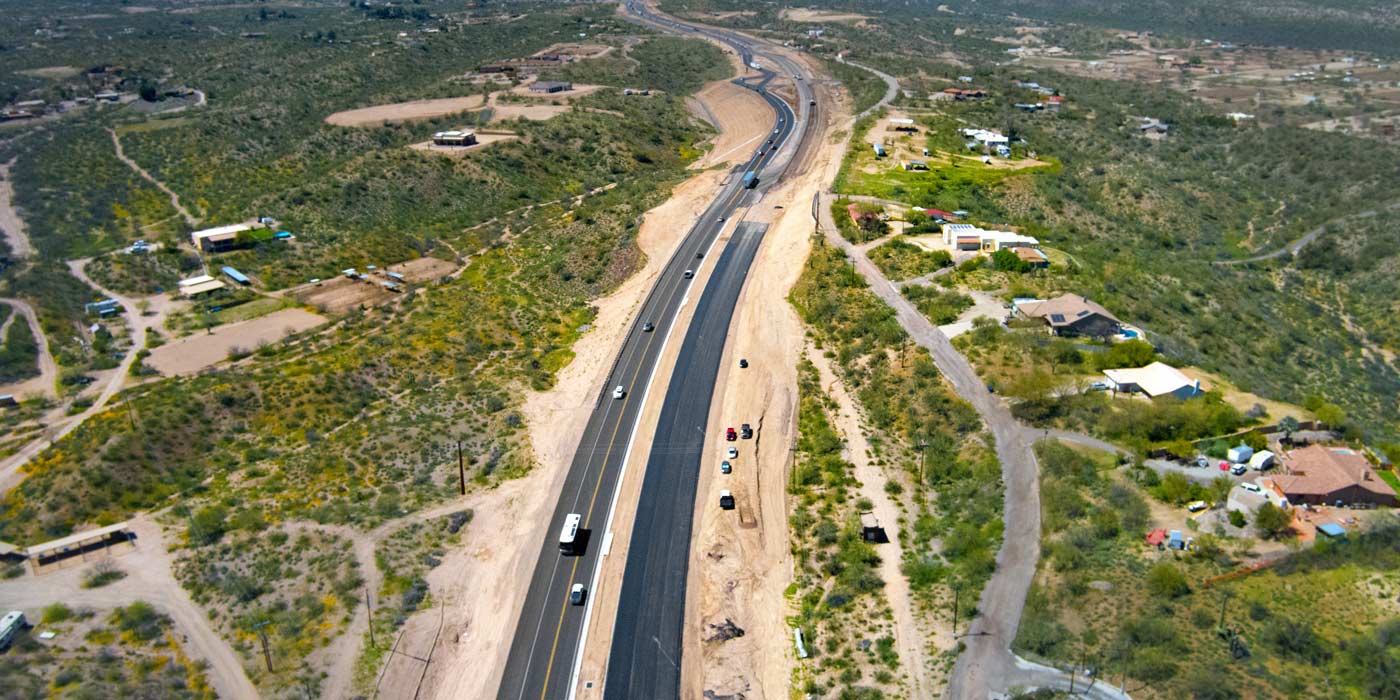
In the mid to late 2020s, the global road and bridge construction market keeps expanding, driven by urbanization, transport network upgrades, and supply chain changes. New projects grow alongside maintenance of existing roads and bridges. Asia-Pacific delivers most new growth, while North America and Europe focus on upgrades. Projects are getting larger, faster, and built to higher technical standards. This chapter analyzes global and regional market size, investment structure, and medium- to long-term growth, highlighting the industry’s current stage and future drivers.
Global Market Size and Growth Rate
Over the past decade, the global market has grown steadily despite economic cycles, showing infrastructure investment’s long-term and policy-driven nature. Since the 2020s, city clusters, economic corridors, and renewal of aging transport assets have shifted growth from pure expansion to a combined model of new construction, rehabilitation, and smart upgrades. Road and bridge projects still take the largest share of transport infrastructure investment and remain the core sector shaping overall market size.
Total Investment Scale and CAGR
Globally, road and bridge construction has reached a stable trillion-dollar annual investment level and keeps medium-to-high growth in the mid-term. Growth comes from steady fiscal support, transport modernization plans, and regional connectivity programs, which provide long-term funding for the sector.
| Global Road and Bridge Construction Market Size and Growth Range (by Investment) | |||
|---|---|---|---|
| Year | Global Market Size (USD trillion) | Annual Growth Range | Key Background |
| 2020 | 1.9 – 2.1 | — | Project delays during the pandemic |
| 2023 | 2.3 – 2.5 | 5% – 6% | Economic recovery and stimulus |
| 2025 | 2.6 – 2.9 | ~6% | City clusters and logistics corridors |
| 2030 (Forecast) | 3.5 – 3.9 | 5% – 6% | New builds plus asset renewal |
Growth drivers include:
- Policy-led investment: transport remains a top fiscal stimulus tool;
- Rigid urban demand: cities keep expanding roads and expressways;
- Supply chain security: cross-regional logistics corridors gain priority.
Overall, market growth depends more on long-term structural demand than on single economic cycles.
Investment Structure: Roads vs. Bridges
Within transport infrastructure, road projects still take the largest share. However, bridge projects keep gaining weight in unit cost, technical complexity, and capital intensity, especially in urban clusters, river and sea crossings, and mountain expressways.
| Global Investment Structure of Road and Bridge Construction | ||
|---|---|---|
| Project Type | Investment Share | Investment Features |
| Roads and Expressways | 65% – 70% | Long routes, high volume, continuous construction |
| Bridge Projects | 20% – 25% | High unit cost, complex technology |
| Interchanges and Hubs | 5% – 8% | Key urban traffic nodes |
| Auxiliary Works | 3% – 5% | Drainage, protection, traffic facilities |
Structural trends: More long-span bridges and multi-level interchanges; More elevated roads and composite transport structures in cities; Rising capital share of bridge projects in total investment. This trend pushes contractors and equipment suppliers to upgrade toward complex structural engineering capabilities.
New Construction vs. Rehabilitation Markets
As large volumes of transport assets enter mid-to-late service life, rehabilitation and upgrading now drive stable growth, and in developed economies they already exceed new construction.
| Share of New Build vs. Rehabilitation by Region | |||
|---|---|---|---|
| Region | New Build Share | Rehab & Strengthening Share | Market Stage |
| North America | 30% – 40% | 60% – 70% | Asset maintenance dominated |
| Europe | 35% – 45% | 55% – 65% | Safety and green upgrades |
| Asia-Pacific | 60% – 70% | 30% – 40% | Expansion still ongoing |
| Middle East | 70%+ | <30% | New cities and corridors |
| Africa | 75%+ | <25% | Network expansion stage |
Construction impacts: Rehab projects focus on short schedules, low traffic disruption, and precise work; New builds require high-capacity, continuous operations and fast delivery; Equipment must support both mass paving and precision construction. The market is shifting to a dual-engine model of asset renewal and network expansion, rather than relying only on new builds.
Regional Market Size Distribution
As global economic structures shift and infrastructure strategies adjust, the road and bridge construction market shows clear regional differences. Economic development levels, network maturity, policy priorities, and financing models shape both market size and growth patterns. Overall, Asia-Pacific remains the largest growth engine, while North America and Europe focus on renewal and upgrading. The Middle East, Africa, and Latin America show strong potential in new construction, but with higher uncertainty. This section reviews market scale and structure across five major regions.

| Regional Market Size and Growth Comparison | ||||
|---|---|---|---|---|
| Region | 2025 Market Size (USD tn) | 2030 Forecast (USD tn) | CAGR 2025–2030 | Core Growth Drivers |
| Asia-Pacific | 1.05 | 1.38 – 1.60 | 5.8% – 6.3% | Urbanization + New corridors |
| North America | 0.62 | 0.70 – 0.78 | 3.2% – 4.0% | Maintenance + Smart upgrades |
| Europe | 0.51 | 0.55 – 0.62 | 2.5% – 3.5% | Green transition + Safety |
| Middle East & Africa | 0.18 | 0.25 – 0.32 | 7.0% – 9.0% | Network expansion + Financing |
| Latin America | 0.14 | 0.18 – 0.23 | 4.0% – 6.0% | Logistics corridors + Regional links |
Asia-Pacific: The Largest Growth Market
Large populations, rapid urbanization, and strong demand for network expansion keep Asia-Pacific in the lead. China, India, and Southeast Asia continue to invest heavily in highways, inter-regional corridors, and urban expressways.
| Asia-Pacific: The Largest Growth Market Size and Growth | |||
|---|---|---|---|
| Indicator | 2023 | 2025 | 2030 (Forecast) |
| Market size (USD trillion) | 0.92 | 1.05 | 1.38 – 1.60 |
| Share of global market | ~38% | ~39% | ~39% – 41% |
| CAGR | 6.5%+ | 6.2% | 5.8% – 6.3% |
Urban expansion and road capacity upgrades move in parallel.
Regional connectivity corridors drive cross-border projects.
Manufacturing and logistics upgrades require higher-grade road networks.
High concentration of expressways and long-span bridges.
Complex terrain increases engineering difficulty.
Private capital and international financing play a growing role.
North America: Renewal-Dominated Market
North America focuses mainly on maintenance, reinforcement, and smart upgrades. Many roads and bridges built in the mid-to-late 20th century now require major renewal.
| North America: Renewal-Dominated Market Size and Growth | |||
|---|---|---|---|
| Indicator | 2023 | 2025 | 2030 (Forecast) |
| Market size (USD trillion) | 0.58 | 0.62 | 0.70 – 0.78 |
| Share of global market | ~24% | ~23% | ~20% – 21% |
| CAGR | 3.5% | 3.8% | 3.2% – 4.0% |
Many small and scattered bridge repair projects.
ITS upgrades receive strong policy support.
High labor costs push automation and mechanization.
Safety improvement and risk control of aging assets.
Road upgrades linked to urban redevelopment and rail access.
Integration of smart traffic management systems.
Europe: Green and Safety-Oriented Investment
Policy and green transition strongly influence Europe’s market. Governments stress carbon reduction, environmental compliance, and safety, which raises technical standards and project complexity.
| Europe: Green and Safety-Oriented Investment Market Size and Growth | |||
|---|---|---|---|
| Indicator | 2023 | 2025 | 2030 (Forecast) |
| Market size (USD trillion) | 0.48 | 0.51 | 0.55 – 0.62 |
| Share of global market | ~20% | ~19% | ~15% – 16% |
| CAGR | 2.5% | 3.0% | 2.5% – 3.5% |
High share of rehabilitation and safety upgrades.
Strict noise and emission rules promote green construction methods.
Projects often combine with urban renewal and slow-traffic systems.
EU green infrastructure policies and carbon regulations.
High durability and safety standards.
Demand for cross-border freight and urban traffic integration.
Middle East & Africa: New Network Construction
Middle Eastern countries invest in new cities and logistics hubs, while many African countries still work to complete basic national road networks.
| Middle East & Africa: New Network Construction Market Size and Growth | |||
|---|---|---|---|
| Indicator | 2023 | 2025 | 2030 (Forecast) |
| Market size (USD trillion) | 0.16 | 0.18 | 0.25 – 0.32 |
| Share of global market | ~7% | ~7% | ~7% – 8% |
| CAGR | 7.0%+ | 7.5% | 7.0% – 9.0% |
Middle East focuses on hubs and international corridors.
Africa still needs large-scale road network expansion.
Extreme climates raise construction and maintenance costs.
Coastal economic belts and trunk highway systems.
More funding from multilateral banks and PPP models.
Urban growth and industrial park connectivity needs.
Latin America: Regional Connectivity and Logistics Corridors
Fiscal limits, complex terrain, and political volatility slow investment, but demand for cross-border logistics corridors and port access roads remains strong.
| Latin America: Regional Connectivity and Logistics Corridors Market Size and Growth | |||
|---|---|---|---|
| Indicator | 2023 | 2025 | 2030 (Forecast) |
| Market size (USD trillion) | 0.12 | 0.14 | 0.18 – 0.23 |
| Share of global market | ~5% | ~5% | ~4% – 5% |
| CAGR | 4.5% | 5.0% | 4.0% – 6.0% |
Mountains and rainforests raise construction difficulty.
Public budget swings affect project schedules.
Projects rely heavily on development banks and global contractors.
Cross-national highway corridors.
Port-to-hinterland logistics routes.
Industrial and agricultural export channels.
Road and Bridge Construction Industry Outlook for the Next 5–10 Years
As the global economy recovers steadily, while supply chains restructure and climate targets tighten, road and bridge construction is shifting from scale-driven growth to structure-driven upgrading. Over the next 5–10 years, the market will continue to grow at a mid-to-high rate. New demand will mainly come from network expansion in emerging economies, rehabilitation in mature markets, and the rollout of green and smart transport systems. In the long term, three trends will dominate: wider regional gaps, faster investment restructuring, and higher technical entry barriers.

Medium- to Long-Term Global Market Forecast
Supported by population growth, urbanization, and logistics demand, the global road and bridge construction market will expand steadily through 2030, and then move into an upgrade-led stage.
| Global Road & Bridge Construction Market Forecast | ||
|---|---|---|
| Year | Market Size (USD tn) | YoY Growth Range |
| 2025 | 2.6 – 2.8 | 5.5% – 6.5% |
| 2030 | 3.5 – 3.8 | 5.0% – 5.8% |
| 2035 | 4.3 – 4.8 | 4.0% – 5.0% |
Trend interpretation:
- 2025–2030: New builds and upgrades expand at the same time, keeping growth high.
- 2030–2035: Mature markets focus on deep rehabilitation. Growth slows, but project value and technical standards rise.
- The industry shifts from volume-driven to quality-driven growth.
Growth Focus Shifts Further to Asia-Pacific and Africa
Most new global transport investment over the next decade will come from Asia-Pacific and parts of Africa. Regional imbalance will continue to widen.
| Regional Contribution to New Investment (2025–2035) | ||
|---|---|---|
| Region | Share of New Global Investment | Main Sources of Growth |
| Asia-Pacific | 45% – 50% | Highway expansion, cross-regional corridors, urban expressways |
| Middle East & Africa | 15% – 20% | National trunk roads, port access corridors |
| North America | 12% – 15% | Bridge repair and ITS upgrades |
| Europe | 10% – 12% | Green transport retrofits, bridge replacement |
| Latin America | 6% – 8% | Logistics corridors, rural road upgrades |
Structural shifts: Asia-Pacific remains the core market, with rising complexity and stricter environmental standards. African countries enter a peak phase of basic network construction. Developed economies move fully from new builds to safety, durability, and smart upgrades.
Investment Structure Shifts Toward Upgrading and Retrofits
Project mix will change, with rehabilitation and functional upgrades taking a larger share.
| Global Investment Structure Trend | |||
|---|---|---|---|
| Project Type | 2025 | 2030 | 2035 (Forecast) |
| New roads & bridges | 55% | 48% | 42% |
| Rehabilitation & strengthening | 25% | 30% | 35% |
| Smart & green upgrades | 20% | 22% | 23% |
Key directions: Fast growth in bridge monitoring, strengthening, and durability upgrades. Intelligent road systems become a new demand driver. Higher requirements for equipment precision, continuity, and environmental performance.
Technology and Construction Models Reshape the Industry
Technology upgrades will strongly affect competitiveness, and industry concentration is likely to rise.
Key Technology Trends
Industry impact: Large contractors and system solution providers gain stronger advantages. Small and mid-sized firms face pressure from equipment and tech upgrades. Integrated procurement of equipment + methods + digital platforms becomes common.
Direct Impact on Contractors and Equipment Markets
Rising project complexity increases demand for integrated and adaptable equipment systems.
Equipment demand by project stage
Procurement trends:
- Stronger focus on adaptability to complex site conditions.
- Higher expectations for delivery speed and local service support.
- Shorter project cycles drive demand for multi-functional and fast-relocation equipment.
Technology Trends and Equipment Transformation in Global Road & Bridge Construction
As projects grow larger, schedules tighten, and environmental rules become stricter, road and bridge construction is shifting from experience-based work to technology-intensive, equipment-led, and system-integrated delivery models. Digital management, prefabrication, low-carbon processes, and smart equipment now improve efficiency, quality stability, and site safety. At the same time, equipment is evolving from single machines to integrated and intelligent system solutions, reshaping project organization and industry competition.

Digital Construction and Smart Jobsite Systems
With larger and more complex projects, traditional paper-based and experience-driven management can no longer meet today’s needs for schedule control, traceable quality, and measurable safety. Smart jobsite systems integrate BIM, IoT, positioning, video analytics, and cloud platforms to manage progress, resources, equipment, and worker safety in real time. These tools are moving from pilot use to standard practice on major projects and have become essential for reliable project delivery.
Deep Application of BIM and Digital Twins in Construction
BIM has evolved from a design support tool into a core platform for construction planning and schedule control. When linked with real-time sensor data, it forms digital twin systems that enable synchronized virtual-physical management.
| Main Functions and Impacts of BIM and Digital Twins | ||
|---|---|---|
| Application Area | Function | Direct Value |
| Process simulation | Clash detection and path optimization | Rework reduced by 15%–25% |
| Schedule control | 4D simulation and dynamic updates | Schedule shortened by 8%–15% |
| Quantity tracking | Auto take-off and material monitoring | Cost variance within ±3% |
| Structural health | Linked with monitoring sensors | Early risk detection |
On large bridges, complex interchanges, and tunnel clusters, the combination of BIM and sensor monitoring has become essential for safety control and multi-trade coordination.
Smart Equipment and Automated Precision Control
Digitalization now extends into equipment control systems and turns machines into real-time data nodes. Key processes such as paving, compaction, and mixing are shifting toward automated control and closed-loop adjustment.
| Typical Smart Construction Systems and Results | ||
|---|---|---|
| System Type | Technology | Performance Improvement |
| Intelligent compaction | GNSS + sensor feedback | Uniformity improves by 20%+ |
| Auto leveling systems | Dual laser & satellite control | Smoothness improves by 25%–35% |
| Automatic proportioning | Online weighing with feedback | Material waste drops by 5%–10% |
| Fleet coordination | Position and output linkage | Idle time reduced by 15%–25% |
Quality control shifts from post-inspection to real-time process control, which reduces rework and quality disputes.
Equipment Connectivity and Predictive Maintenance
With connected equipment and continuous data collection, contractors can manage fleets across projects and move from reactive repairs to predictive maintenance.
| Management Improvements from Digital Maintenance | ||
|---|---|---|
| Area | Traditional Mode | Digital Mode |
| Fault detection | Manual inspection | Real-time alerts |
| Maintenance method | Breakdown repair | Predictive servicing |
| Spare parts | Experience-based stocking | Lifecycle-based supply |
| Project dispatch | Manual coordination | System-recommended scheduling |
Overall results: Downtime reduced by 20%–40%, Annual maintenance cost reduced by 10%–18%, Cross-project utilization increased by 10%+. These gains are especially important for large contractors working across multiple regions.
Structural Impact on Project Organization
Digital systems do more than support operations. They also reshape project organization:
Observed results: Project delay risk is decreased by 20%–30%. Accident rate reduces 25%–40%. Management staffing decreases about 10%–15%. For future projects with high standards and complex structures, the level of digital construction capability will directly affect whether contractors and equipment suppliers can enter high-end project supply chains.
Development of Prefabricated and Industrialized Construction Technologies
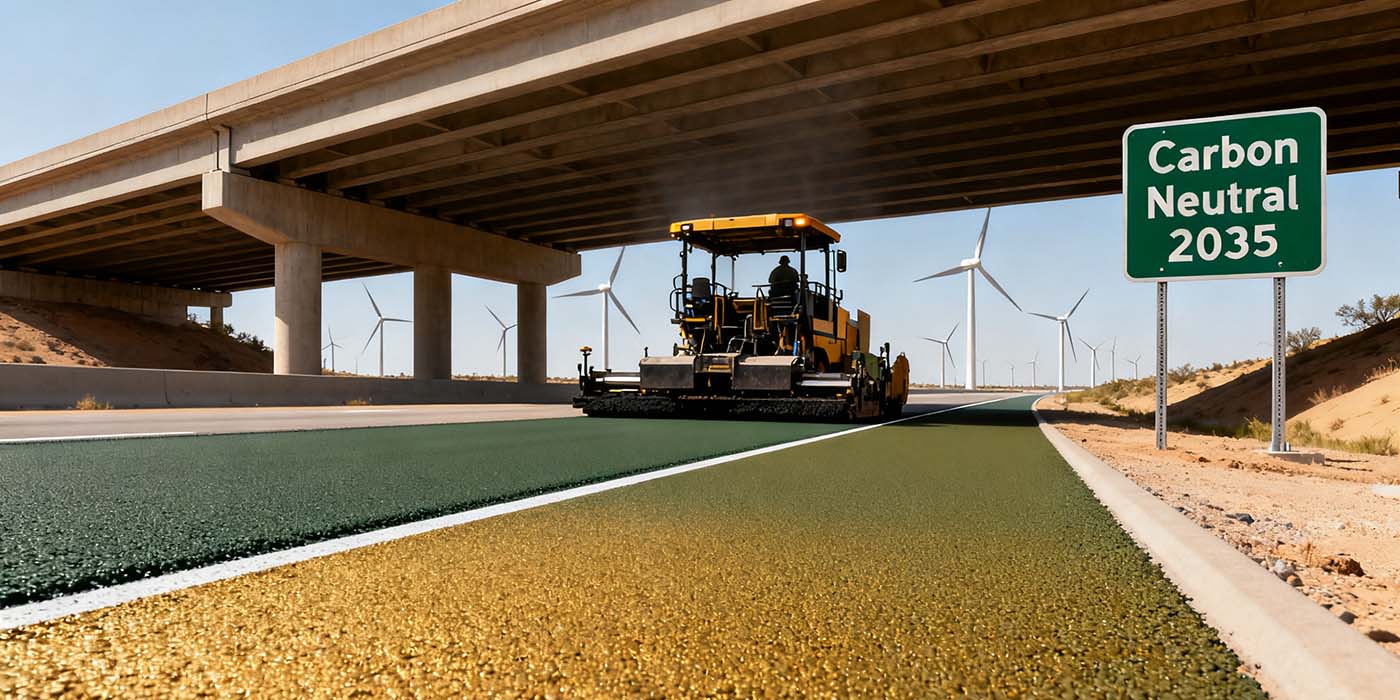
As labor costs rise, safety standards tighten, and urban construction windows keep shrinking, traditional cast-in-place methods can no longer balance speed and quality. Prefabricated and industrialized construction shifts major structural work to factories and follows a “factory production + rapid on-site assembly” model. This approach shortens project cycles and cuts high-risk site work, making it a key direction for bridge projects and selected road structures.
Large-Scale Use of Precast Girders and Deck Systems
Precast beams and deck panels now form mature systems in expressways, urban viaducts, and interchange projects. They fit best in projects with standard spans and repetitive structures.
| Cast-in-Place vs. Prefabricated Bridge Construction | ||
|---|---|---|
| Comparison | Cast-in-Place | Prefabricated |
| On-site construction time | Long | 30%–50% shorter |
| High-altitude work | High | Much lower |
| Quality stability | Affected by environment | Factory-controlled |
| Weather dependence | Strong | Weak |
| Public disturbance | High | Lower |
Typical applications: Urban elevated expressways, Highway interchanges and Small- to mid-span river and overpass bridges.
Modular Bridges and Rapid Construction Methods
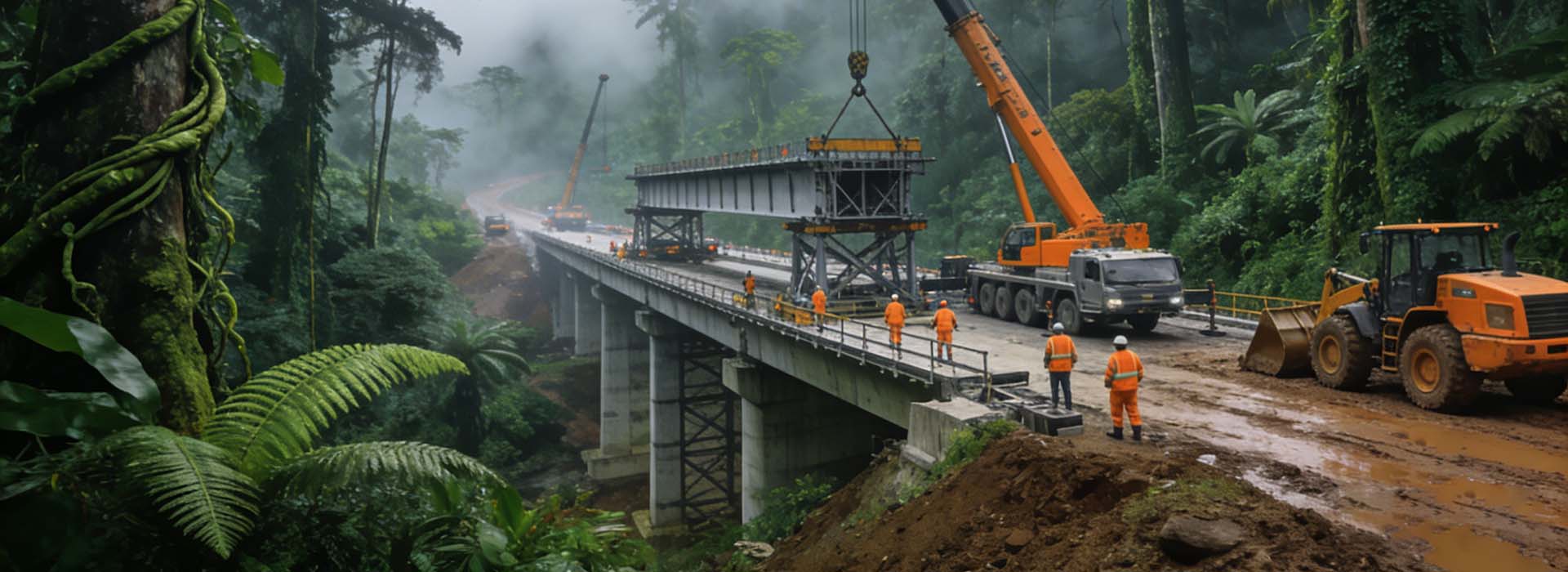
Modular bridge systems show clear advantages in disaster recovery, traffic-maintained construction, and temporary access restoration. Factories produce full or segmented modules, while sites focus on fast lifting and connection.
Technical features: Standardized module interfaces, Quick-lock connection system and Minimal wet work on site.
Efficiency comparison: Compared with traditional construction, modular methods shorten single-span construction from weeks or months to just hours or days, reduce traffic closure time by over 70%, and cut workforce demand by about 40%–60%, significantly improving overall project efficiency.
These systems work especially well in emergency repairs and night-time urban construction windows.

Impact on Concrete and Component Manufacturing Systems
Prefabrication raises demands on dimensional accuracy, material consistency, and supply continuity. This drives component plants toward automated and continuous production.
Key upgrades:
- Batching: Automatic weighing with closed-loop control.
- Mixing: High-uniformity forced mixing.
- Molds: Fast changeover and standardized interfaces.
- Curing: Steam or constant-temperature smart curing.
Results: Strength variation drops by 20%–30%; Batch quality becomes more stable; Component turnaround time shortens
Direct Impact on Equipment Configuration and Site Logistics
Prefabrication shifts equipment demand from earthwork-focused machines to lifting, transport, and positioning systems.
New Equipment Requirements under Prefabricated Construction
- Component transport: Heavy-duty flatbed systems.
- Lifting: Large crawler or truck cranes.
- Precise installation: High-accuracy positioning and synchronized control.
- Continuous operation: High-reliability hydraulic systems.
Site logistics must also align plant output with installation pace, requiring tighter scheduling and coordination.

In the coming years, prefabrication will expand further in bridge projects and extend to selected road structures and auxiliary works, with lasting impact on construction methods and equipment systems.
Green and Low-Carbon Construction Processes and Environmental Equipment Upgrades
Driven by global carbon-neutral targets and stricter environmental regulations, road and bridge construction is shifting from efficiency-only approaches to balancing performance with environmental impact and full life-cycle emissions. The construction phase, a major source of carbon emissions, is highly influenced by material choice, processes, and equipment energy efficiency. Green construction has moved from policy guidance to a key factor in project qualification and bidding, driving process innovation and equipment upgrades.

Promotion of Low-Carbon Materials and Energy-Saving Construction Processes
Material-side emission reduction is one of the core pathways for low-carbon transformation in road and bridge construction. By lowering production energy consumption and increasing material recycling rates, projects can achieve source-level emission reductions.
| Comparison of Major Low-Carbon Materials and Processes | ||
|---|---|---|
| Technology / Material | Key Features | Environmental Benefits |
| Warm Mix Asphalt (WMA) | Mixing temperature reduced by 20–40°C | CO₂ emissions reduced by 15%–30% |
| High-RAP Recycled Asphalt | RAP content of 30%–60% | Virgin asphalt consumption reduced by over 20% |
| Recycled Stabilized Base | Reuse of existing pavement materials | Less waste disposal and lower transport emissions |
| Low-Clinker Cement | Reduced clinker ratio | Cement-related CO₂ reduced by 10%–20% |
In Europe, North America, and parts of the Asia-Pacific region, the share of recycled materials in both new construction and maintenance projects continues to rise. In some regions, minimum recycling rates have already become mandatory bidding requirements.
Upgrade Directions for Environmentally Friendly Mixing Plants and Construction Equipment
Construction equipment is a key control point for emissions and pollution during the construction phase. Upgrade priorities focus on four main areas: combustion systems, dust collection, noise control, and energy-efficiency management.
| Key Upgrade Areas for Environmental Construction Equipment | ||
|---|---|---|
| Equipment System | Upgrade Direction | Compliance and Operational Value |
| Combustion System | Low-NOx burners, precise fuel control | Meets NOx emission standards |
| Dust Collection | Pulse-jet cleaning + secondary filtration | Significant reduction in particulate emissions |
| Noise Control | Fully enclosed structures and sound insulation | Suitable for urban night construction |
| Energy Management | Variable-frequency drives and smart start-stop | Energy savings of 8%–15% |
In urban road rehabilitation projects and in areas near airports and ports, environmentally compliant mixing plants and low-noise equipment have become basic entry requirements.
Electrification and New Energy Trends in Construction Equipment
With the rapid development of battery and electric-drive technologies, some construction equipment is shifting toward electric and hybrid power, especially in emission-sensitive areas.
Key Application Scenarios: Urban core construction zones, Tunnels and underground works and Night construction and residential areas.
| Comparison of Electrified Construction Equipment | ||
|---|---|---|
| Indicator | Diesel Equipment | Electric / Hybrid Equipment |
| Exhaust Emissions | Present | Near-zero on site |
| Noise Level | High | Reduced by 30%–50% |
| Operating & Maintenance Cost | Relatively high | Lower over long term |
| Initial Investment | Lower | Higher |
Although upfront investment remains higher, policy incentives and lower operating costs are rapidly improving the economic feasibility of electric equipment in specific construction scenarios.
Carbon Accounting and Green Construction Evaluation Systems
Green construction is expanding from individual technologies to full-process carbon accounting and performance evaluation systems, becoming an integral part of large-scale project management.
Key Management Focus Areas:
Impacts on Project Delivery: Green indicators directly affect bid success rates, Continuous equipment upgrades by contractors are encouraged andFaster large-scale adoption of low-carbon processes.
Integrated Construction Equipment and System Solution Trends
As road and bridge projects become larger, more systematic, and higher-standard, single machines can no longer ensure continuous operation and stable quality. Construction firms are shifting from traditional “single-machine procurement” to “integrated equipment + full-process solutions,” emphasizing capacity matching, process coordination, and system stability. This trend improves efficiency and reduces bottlenecks caused by equipment mismatches.

From Single-Machine Procurement to Integrated System Configuration
Key construction processes now require multiple types of equipment working continuously. Any weak link can limit overall output.
| Comparison: Single-Machine Procurement vs. Integrated System Solutions | ||
|---|---|---|
| Dimension | Single-Machine Procurement | Integrated System Solution |
| Capacity Matching | Prone to bottlenecks | Unified, optimized design |
| Process Continuity | Easily interrupted | Continuous and stable |
| Commissioning Time | Long | Reduced 30%–50% |
| Project Ramp-Up | Slow | Faster to full capacity |
| Quality Stability | Variable | Controlled and stable |
Integrated solutions are particularly effective for continuous-operation projects such as highways, airport runways, and port access roads.
Typical Integrated Equipment Configurations by Construction Stage
Integration applies not only to equipment quantity but also to systematic combinations aligned with construction processes.
| Integrated Equipment Systems for Road & Bridge Construction | ||
|---|---|---|
| Construction Stage | Integrated Equipment Combination | Core Value |
| Subgrade Construction | Stabilized soil mixing plant + Paver + Compaction equipment | Ensures base strength and uniformity |
| Pavement Construction | Asphalt plant + Paver + Intelligent compaction system | Stable pavement structure quality |
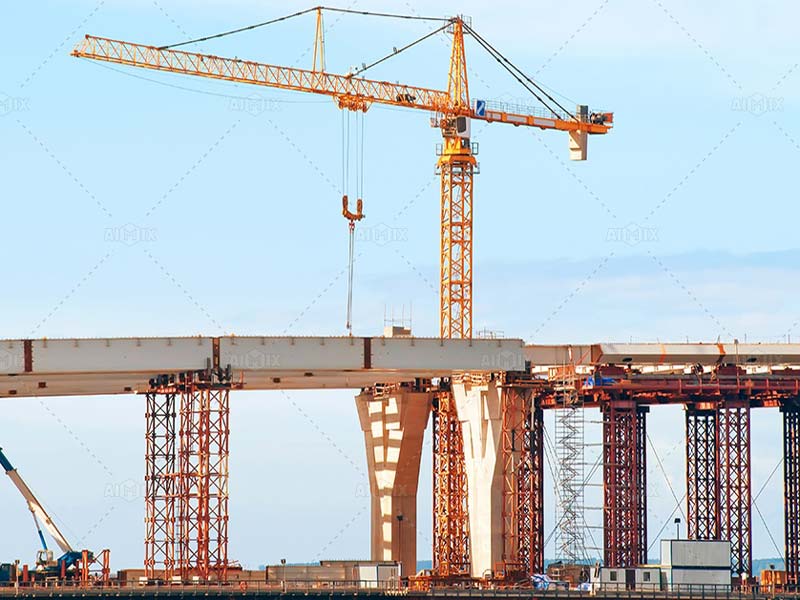
| Bridge Construction | Concrete batching plant + Pumping system + Erection equipment | Continuous pouring & safe lifting |
| Maintenance & Repair | Mobile crushing plant + Recycled mixing equipment | Rapid restoration of traffic capacity |
This systematic configuration supports standardized project organization and reduces reliance on individual experience.
System Solutions Redefining the Role of Equipment Suppliers
Clients increasingly focus on overall construction capability, expanding supplier competition beyond product performance to include solution design, process coordination, and service network capabilities.
Upgraded Requirements for Equipment Suppliers
- Solution Design: Customized configuration based on project conditions.
- Process Understanding: Deep involvement in construction workflow planning.
- Delivery Capability: Synchronized delivery and commissioning of integrated equipment.
- Service Network: Localized maintenance and spare parts support.
- Training System: Systematic operation and maintenance training.
This drives road construction equipment suppliers to transform from “manufacturers” into “construction solution providers.”

Impact on Construction Organization and Project Management
Integrated equipment systems significantly reshape project management:
Scheduling now prioritizes system capacity.
Quality control moves forward to batching and measurement systems.
Project progress becomes less sensitive to individual equipment performance.
Risk shifts from multiple equipment uncertainties to system-level controllability.
Impact Metrics
Overall Project Efficiency: increased by 10%–20%.
Quality Variability: reduced by 15%–25%.
Equipment Utilization: increased by over 10%.
Management Complexity: significantly lowered.
For high-standard projects, suppliers with integrated delivery capability and local service networks are more likely to enter the core supply chain of major contractors.
Different Climate and Geological Impacts on Construction Techniques
Global road and bridge projects span diverse environments—from hot, rainy tropics to freeze-thaw regions, soft soil, mountainous rock, and corrosive coastal zones. Climate and geological conditions strongly influence design, construction methods, material choice, and equipment needs. Matching construction technology to these conditions is critical for structural safety, schedule reliability, and life-cycle cost control.

Hot and Rainy Tropical Regions: Focus on Drainage and Durability
In Southeast Asia, South Asia, Latin America, and equatorial Africa, projects face high heat, heavy rain, and high humidity, with annual rainfall often exceeding 2,000–3,000 mm and unstable construction windows. Poor drainage or material durability can cause subgrade failure, early structural damage, and frequent maintenance. Construction priorities should therefore emphasize drainage efficiency, water resistance, and high-temperature stability, rather than only structural strength.
Subgrade Drainage Design Strategies under Heavy Rainfall
Rainwater infiltration is the primary cause of subgrade strength loss. Studies show that a 5%–8% increase in subgrade moisture content can reduce bearing modulus by 30%–50%, significantly shortening pavement life.
| Subgrade Drainage Design Strategies under Heavy Rainfall Common Failure Modes and Countermeasures: | ||
|---|---|---|
| Failure Issue | Engineering Manifestation | Technical Measures |
| Surface water | Pavement infiltration, crack propagation | Increase cross slope ≥2.0%, improve surface drainage |
| Subgrade saturation | Strength reduction, rutting | Install permeable sub-base + longitudinal blind drains |
| Slope erosion | Landslides, collapse | Multi-level interceptor drains + vegetation protection |
Typical drainage structure combinations:
Concrete and Stabilized Soil Durability Control in Hot and Humid Environments
In regions where temperatures remain above 28°C, accelerated hydration can lead to: Plastic shrinkage cracks, Insufficient surface strength and Premature steel corrosion.
Material optimization strategies:
High original moisture content and clay content.
Dynamic adjustment of stabilizer dosage.
Uniform mixing directly affects structural lifespan.
Real-time adjustment of water and stabilizer ratios.
Continuous output ensures material consistency.
Suitable for short rainy-season construction windows.
Asphalt Pavement High-Temperature Stability and Water Damage Control
In tropical urban roads, surface temperatures can reach 60–70°C. Single-focus material designs risk: High-temperature rutting, Aggregate stripping from water damage and Surface layer loosening.
Asphalt mix design focus:
- High-temperature resistance: SBS-modified asphalt, dense skeleton structure.
- Water damage resistance: Improve mineral filler quality and asphalt film thickness.
- Drainage: Open-graded or semi-drainage pavement structure.
Asphalt plant equipment requirements:
Dryer system must handle high-moisture aggregates.
Burner system must maintain stable thermal efficiency.
Finished material silo requires insulation to reduce temperature drop.

Construction Organization and Equipment Adaptation
In countries with pronounced rainy seasons, available construction days are often below 60%–70% of the year. Construction organization must focus on high-efficiency integrated operations.
Organization optimization strategies:
- Reduce process switching: Continuous batching → transport → paving.
- Lower rework rate: Complete drainage and base layers in advance.
- Increase daily output: Night work + rapid curing techniques.
Equipment configuration trends:
- Mobile asphalt batching plants: close to work zones to reduce rainy-season transport risks.
- Integrated pumping systems: shorten concrete exposure time and improve forming quality.
- Modular supply systems: quick assembly/disassembly for multi-location rotation.
In hot and rainy tropical regions, competitiveness in road and bridge construction depends not just on structural strength design, but on comprehensive integration of drainage systems, material durability, and continuous construction capability. Only by coordinating structure, material mix, and equipment configuration can projects achieve dual stability in quality and schedule under high-climate-risk conditions.
Cold and Freeze-Thaw Regions: Frost Resistance and Construction Window Management
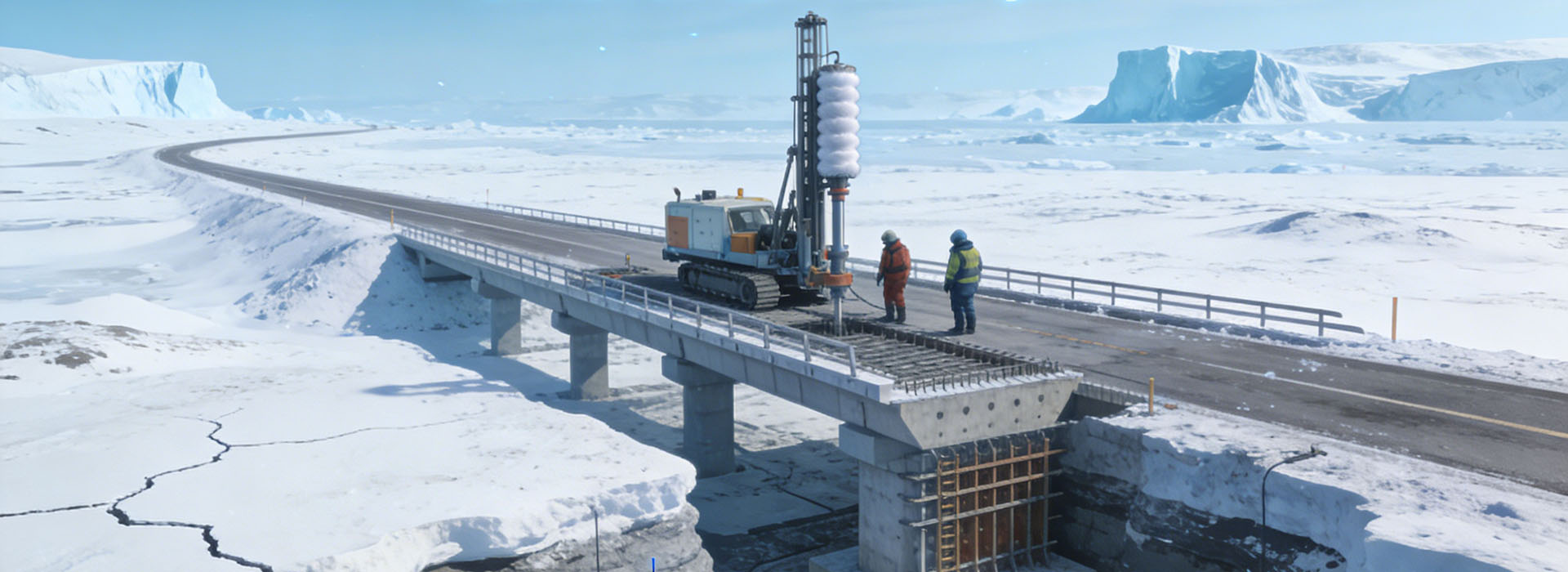
In high-latitude and high-altitude areas, road and bridge projects face repeated freeze-thaw cycles. Soil volume changes and material fatigue drive structural durability decline. Studies show that when annual freeze-thaw cycles exceed 30–50 times, typical pavement failure rates rise sharply, and project lifespan may shorten 30%–50% without targeted design and construction measures. Construction priorities in these regions focus on frost heave control, moisture reduction, enhanced material freeze resistance, and maximizing output during limited construction seasons.
Frost Heave Mechanism and Subgrade Failure Pathways
- Core principle: Frost heave arises from water migration + temperature gradients.
- Freezing: Subgrade uplift, tensile stress in layers.
- Thawing: Rapid load-bearing loss, permanent deformation.
- Multiple cycles: Cracks, rutting, and settlement accumulation.
Soil frost-susceptibility:
- Silt: Very high.
- Fine sand: Medium.
- Clay: Medium-high (depends on moisture).
- Gravel: Low.
Frost-Proof Subgrade Design and Material Control
- Core principle: Combine water isolation + replacement + insulation.
- Non-frost-susceptible fill: Block capillary water rise.
- Frost layer: Extend freeze depth below structural layers.
- Drainage layer: Control long-term moisture.
- Insulation layer: Reduce temperature gradient effects.
- Typical layered structure: Surface → Base → Frost Layer (graded gravel / foam concrete) → Original soil.
Material control:
- Moisture: within optimal ±1%.
- Compaction: ≥ 98–100% design value.
- Frost layer thickness: 30–80 cm, based on freeze depth.


Freeze-Resistant Concrete and Asphalt Design
Core principle: Improve pore stability and low-temperature flexibility.
Concrete:
- Air-entraining agent: Microbubbles buffer frost pressure.
- Low water-cement ratio: Reduce free water content.
- Optimized admixtures: Improve pore structure.
- Extended curing: Ensure early strength.
Concrete with 4–6% air content can 1.5–2× increase freeze-thaw resistance.
Asphalt:
Use low-temperature, high-ductility modified asphalt.
Increase fine aggregate for cohesion.
Avoid forced paving and rolling at low temperatures.
Construction Scheduling and Equipment Adaptation
Principle: Maximize daily output, minimize weather-related delays.
Strategies:
Prefabrication to reduce on-site waiting.
Continuous workflow with smart monitoring for rapid correction.
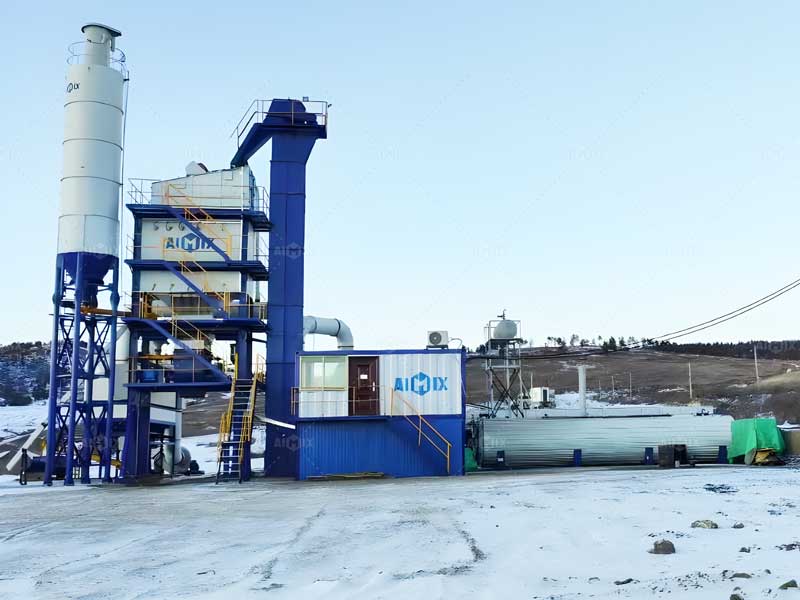
Heated mixing systems, insulated storage, and pipelines.
Modular site setups for phased construction.
Special Techniques for Bridge Foundations on Permafrost
Core principle: Minimize thermal disturbance to maintain permafrost stability.
Methods:
Ventilated pile cooling systems.
Insulation pads under pile caps.
Limit concentrated heat sources during construction.
Insufficient control can reduce bearing capacity by 40%, a critical structural failure mode.
In cold and freeze-thaw regions, success depends on systematically controlling water migration, temperature gradients, and limited construction windows, not just on individual material properties. Coordinated application of frost-proof subgrade systems, freeze-resistant materials, and high-efficiency modular equipment ensures both structural safety and schedule stability under extreme climate conditions.
Soft Soil and High Groundwater Regions: Foundation Reinforcement and Settlement Control Systems
In delta plains, coastal reclamation areas, and river-lake alluvial plains, soft soil and high groundwater often coexist, featuring low bearing capacity, high compressibility, and long consolidation times. Without systematic ground improvement, long-term subgrade settlement can reach 30–100 cm, causing bridge approach bumps, longitudinal pavement cracks, and drainage system failures. Studies show over 60% of early pavement structural defects are directly linked to insufficient ground treatment. Construction priorities in these regions are: rapidly increasing bearing capacity, shortening consolidation cycles, controlling differential settlement, and ensuring long-term operational stability.
Soft Soil Risks and Structural Failure Modes
Soft soil areas present significant engineering challenges due to their low bearing capacity, high compressibility, and slow natural consolidation. The main risks include:
Typical characteristics of soft soils in these regions include:
Moisture content: 40%–90%.
Compression modulus: 1–5 MPa.
Undrained shear strength: 10–25 kPa.
Natural consolidation time: 5–15 years.
Without accelerated ground improvement or artificial consolidation, these conditions can severely impact construction progress and reduce the service life of the infrastructure.
Ground Improvement Techniques and Suitable Conditions
Selection principle: Balance reinforcement effect, construction period, and overall cost.
| Ground Improvement Techniques and Suitable Conditions | |||
|---|---|---|---|
| Technique | Applicable Soil | Main Effect | Construction Time |
| Preloading + Drainage plates | Thick soft clay | Accelerate consolidation | Medium |
| Deep mixing piles | Soft clay / silt | Increase overall strength | Fast |
| CFG piles | Medium-strength soft soil | Bearing + settlement reduction | Fast |
| Dynamic compaction | Fill / mixed soil | Densification | Fast |
| Vacuum preloading | Extremely wet soft soil | Rapid dewatering | Medium |
Practice trends:
- High-grade highways & bridge approaches: composite ground systems (piles + mattress layers).
- Very thick soft soils: vacuum preloading + drainage plates.
- Tight schedules: deep mixing or CFG piles for rapid structure formation.

Drainage and Stability Control in High Groundwater Areas
In regions with high groundwater levels, the primary goal is to reduce pore pressure and prevent shear failure during construction. Key measures include:
- Temporary dewatering wells to lower the groundwater table.
- Longitudinal and transverse blind drains to remove internal water from the subgrade.
- Impermeable isolation layers to prevent lateral seepage.
- Filter layers to prevent fine particle loss and maintain soil stability.
Critical control indicators during construction: Pore pressure increase in the fill should not exceed 20 kPa per week. Layered fill thickness should be maintained at 20–30 cm per layer to avoid overload-induced instability.
Settlement Monitoring and Construction Risk Management
Effective soft soil management relies on monitoring first and adjusting faster than damage occurs. Common monitoring methods include:
- Settlement plates to track consolidation progress.
- Inclinometers to monitor slope stability.
- Piezometers to control overload risk.
- Surface displacement points to detect differential settlement.
Construction control triggers include:
- Settlement rate exceeding 10 mm/day.
- Pore pressure dissipation lower than the design expectation.
- Continuous horizontal displacement of slopes.
When any of these conditions are observed, construction should pause, preloading should be extended, or additional reinforcement measures should be applied.
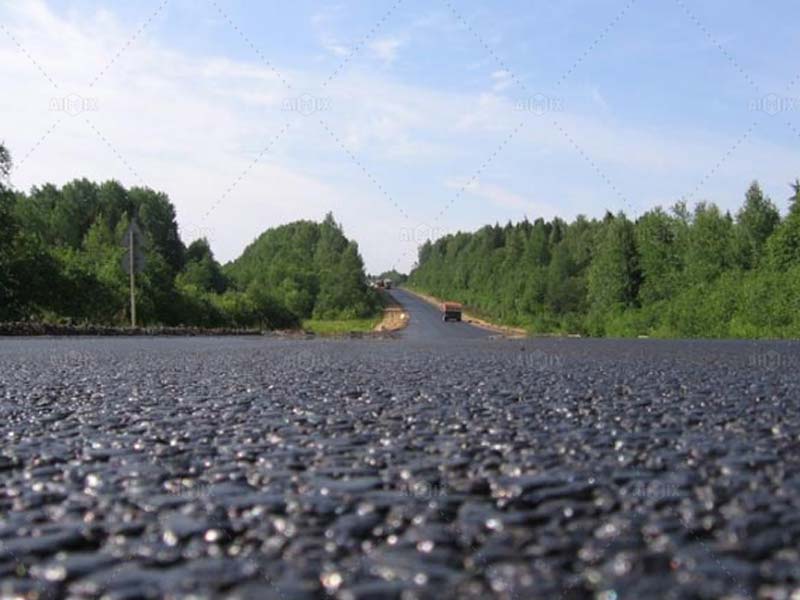
Equipment Configuration for Efficient Soft Soil Treatment
Efficient treatment of soft soil requires equipment capable of continuous operation, precise borehole formation, and stable material delivery. Recommended configurations:
Synergistic benefits of this equipment setup include: Continuous operation from mixing to pumping to pile formation can increase unit productivity by 20–35%. Automatic batching systems maintain mix deviation within ±1%, significantly reducing strength variability and improving long-term soil performance.

Bridge Approach Special Settlement Control
Critical node: Bridge approaches are prone to differential settlement in soft soils.
Control measures:
Gradual stiffness composite foundation zones.
Lightweight fill (foam concrete, EPS blocks).
Extended preloading with secondary loading phase.
Gradual stiffness design can reduce bridge approach settlement differential by 40%–60%, significantly improving ride comfort and structural safety.
In soft soil and high groundwater areas, foundation treatment must lead design. Only coordinated use of composite foundations, full-process monitoring, and stable equipment ensures settlement control, bearing capacity, and timely project delivery.
Mountainous and Rocky Terrain Regions: Slope Stability and Complex Bridge–Tunnel Interface Construction
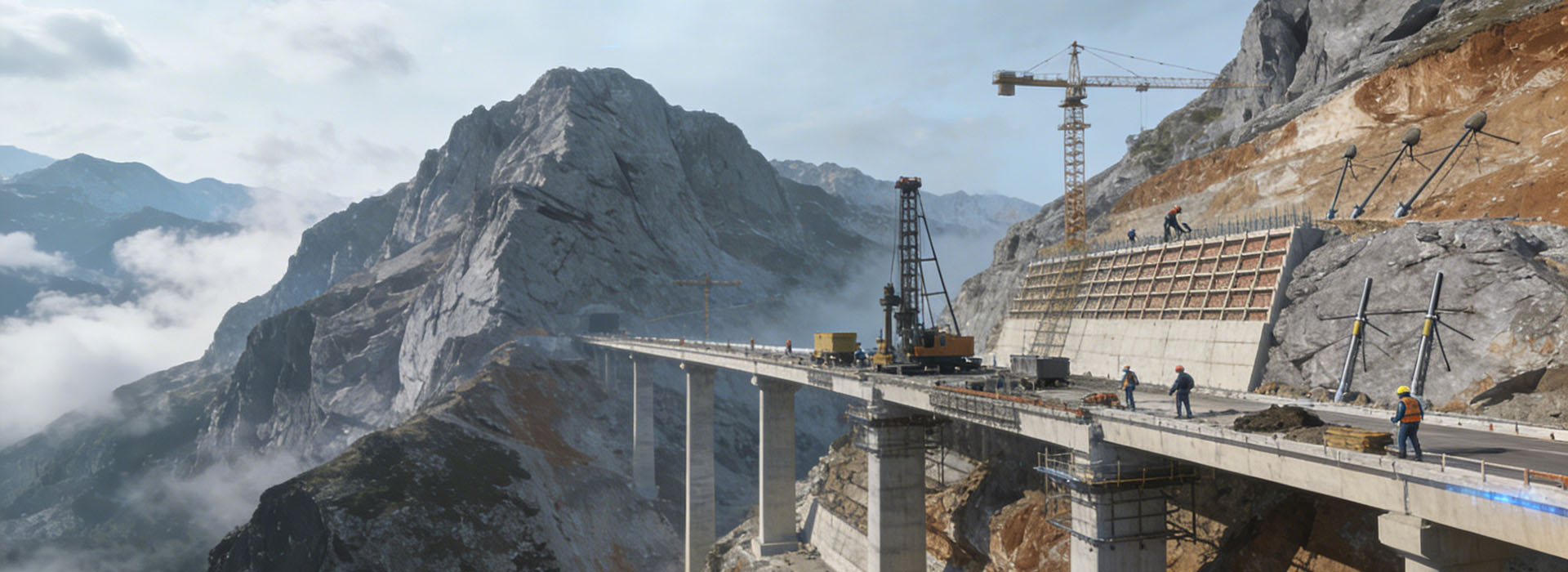
Globally, 35%–40% of new highways are in mountainous or hilly regions, characterized by steep terrain, fragmented rock-soil formations, and complex hydrology. Construction involves high-slope excavation, deep foundations, tall bridge piers, and tunnel intersections. Managing slope stability and sequencing is critical to ensure structural safety and construction efficiency.
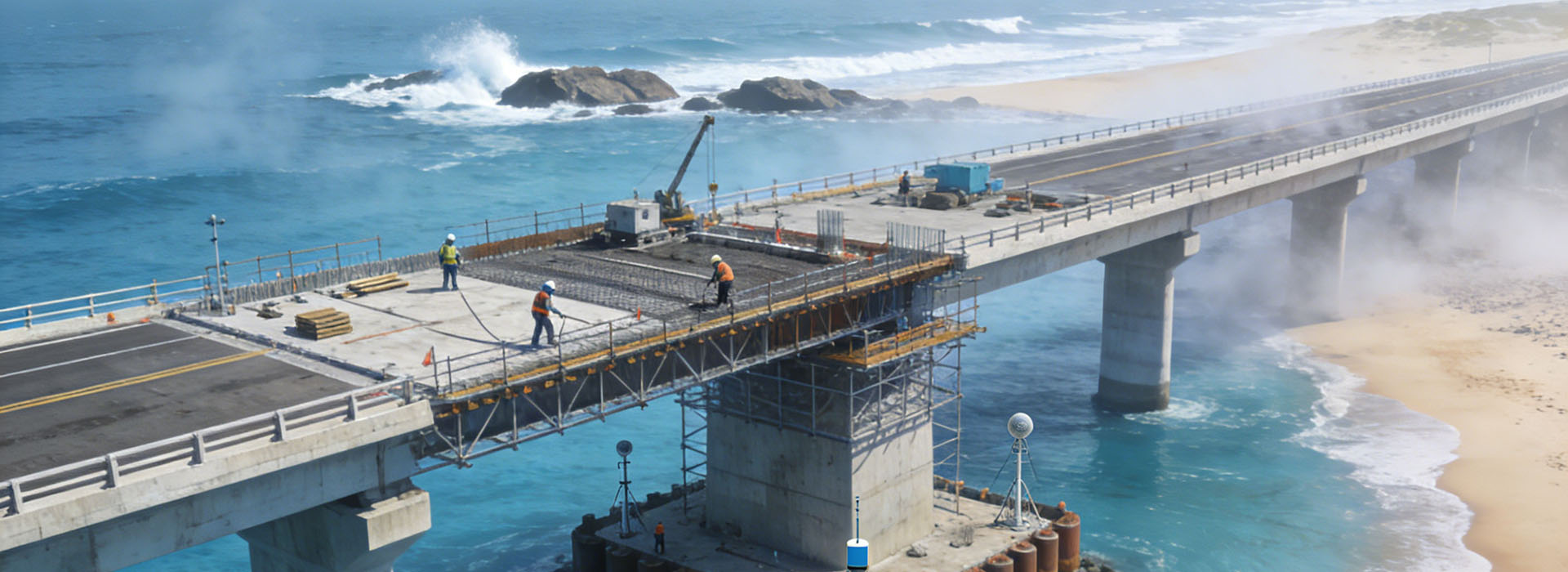
Major Risks and Failure Mechanisms
| Major Risks and Failure Mechanisms | ||
|---|---|---|
| Risk Type | Trigger Factors | Engineering Consequence |
| Landslide | Heavy rainfall + cut slopes | Overall subgrade displacement |
| Collapse | Rock joint development + vibration | Collapse of construction face |
| Slope erosion | Poor drainage | Subgrade washout |
| Deep deformation | Groundwater seepage | Abnormal pile foundation loading |
High-Risk Conditions: Slope height ≥ 30 m, Rock Quality Designation (RQD) ≤ 50%, and Annual rainfall ≥ 1,500 mm.
Under these conditions, slope instability probability rises exponentially, requiring tiered reinforcement and full-process monitoring.
Slope Stability Control System
Core Goal: Stepwise unloading, multi-layer reinforcement, and rapid waterproofing.
| Slope Stability Control System | ||
|---|---|---|
| Technique | Applicable Scenario | Main Function |
| Rock bolts/anchors | Rock slopes | Provide active anti-slip force |
| Frame beams + shotcrete | Weathered rock slopes | Surface stabilization |
| Anti-slide piles | Deep landslide masses | Block sliding surfaces |
| Geogrid vegetation | Surface erosion prevention | Ecological stabilization |
Typical Combination:
- Mid-to-high slopes: anchors + frame beams + drainage holes + surface sealing.
- Landslide remediation: anti-slide piles + subsurface drainage + counter-fill.
- Studies show multi-level protection can reduce slope failure risk by 60%–80%.

Drainage Systems and Structural Stability
Consensus: ≥80% of landslides are water-related.
- Intercepting ditches are set at the top of slopes to block surface runoff from entering the slope body.
- Slope drainage channels are arranged along the slope surface to rapidly discharge rainfall and reduce erosion.
- Deep drainage holes are used to lower internal pore water pressure and prevent deep-seated sliding.
- Subgrade blind drains are installed within road structures to avoid long-term water accumulation and softening.
Design Principles:
- Drainage must be implemented early and formed simultaneously with slopes.
- Channels should handle rainfall recurrence up to 10–20 years.
- Late drainage installation compromises long-term stability.
Bridge–Tunnel Interface Construction
Challenges:
- Stiffness transitions → stress concentration.
- Limited space → cross-interference of multiple operations.
- Variable foundations → high differential settlement risk.
Mitigation Measures:
- Gradual stiffness transition structures.
- Short-pile + cushion composite foundations.
- Enhanced drainage at roadway interfaces.
Practice shows proper transition design can reduce interface structural defects by ≥50%.
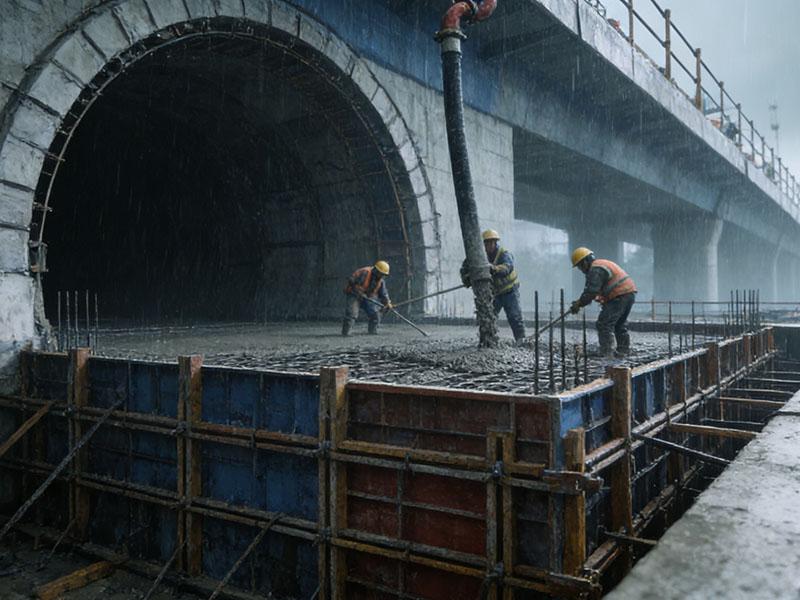

Blasting and Vibration Control
In hard-rock cuttings and tunnel excavation, blasting remains unavoidable, but vibration must be strictly controlled to prevent secondary damage.
Recommended vibration limits are:
- Slope stability: particle velocity should not exceed 5 cm/s.
- Existing structures: particle velocity should not exceed 2 cm/s.
- Sensitive equipment and facilities: particle velocity should be limited to 0.5 cm/s.
Common control techniques include:
- Micro-delay blasting to reduce instantaneous energy release.
- Smooth blasting to protect final excavation surfaces.
- Pre-splitting blasting to isolate vibration and control crack propagation.
Through precision blasting design, excavation efficiency can be maintained while avoiding secondary slope instability.
Mountain Construction Equipment and Organization
Mountain construction requires equipment and organization models that can adapt to narrow, steep, and fragmented work sites.
Equipment configuration should focus on:
- Lightweight crawler drilling rigs capable of operating safely on steep slopes.
- High-lift wet-mix shotcrete systems for rapid and continuous slope support.
- Long-distance pumping systems to deliver concrete and grout across complex terrain.
- Mountain-specific launching gantries for bridge girder erection in confined valleys.
Construction organization should emphasize:
- Strict implementation of rainy-season work restrictions to reduce geotechnical risk.
- Use of advanced geological forecasting to detect weak zones ahead of excavation.
- Strong multi-process coordination and scheduling to avoid operational conflicts and idle time.

In mountainous and rocky terrain, road and bridge construction has become a geology-driven system engineering task. Slope stabilization, drainage systems, bridge–tunnel transition structures, and precise blasting must form a complete technical chain. High-mobility equipment and meticulous construction management are essential to achieve safety, quality, and schedule optimization in high-risk environments.
Core Construction Processes and Technical Systems for Road and Bridge Engineering
As project scales grow, structures become more complex, and environmental and quality standards rise, road and bridge construction has shifted from single-process civil works to an integrated system combining materials engineering, equipment, information technology, and construction management. The coupling among subgrade, pavement, and bridge works is now much stronger, requiring higher levels of process continuity, equipment matching, and real-time quality control. This chapter reviews mainstream technologies and equipment trends in four areas: subgrade and base courses, pavement structures, bridge superstructures, and digital management systems.
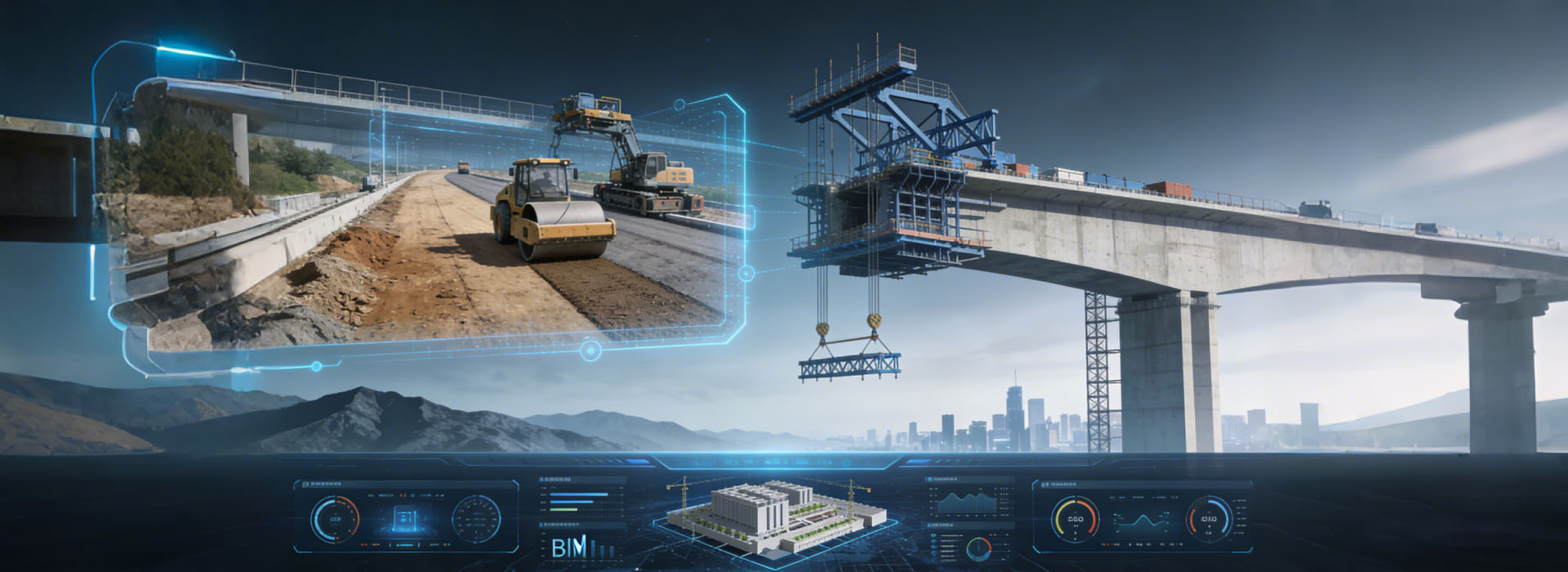
Subgrade and Base Course Construction Technologies
Subgrade and base courses carry traffic loads, control deformation, and ensure pavement durability, making them the most fundamental—and also the most risk-prone—stage in early construction. With higher traffic standards and longer design lives, subgrade construction has moved beyond simple compaction compliance toward systematic control of material performance, structural integrity, and construction processes. Current trends focus on: Composite material stabilization, Continuous construction workflows and Digital quality monitoring.

Application of Stabilized Soil and Recycled Materials
Technical objective: improve bearing capacity while reducing natural aggregate consumption and life-cycle cost.
| Comparison of Stabilization Methods and Engineering Performance | |||
|---|---|---|---|
| Stabilization Method | Strength Increase | Typical Applications | Technical Features |
| Cement-stabilized soil | ↑ 2–4 times | Expressway base courses | High strength, fast early stability |
| Lime-stabilized soil | ↑ 1.5–3 times | Low-grade and rural roads | Low cost, good construction adaptability |
| Cement–fly ash stabilization | ↑ 2–3 times | Industrial park roads | Better shrinkage crack control |
| Foamed asphalt stabilization | Retains original structure strength | Pavement rehabilitation | Fast construction, environmentally friendly |
| Development Trends in Recycling Technologies | ||
|---|---|---|
| Recycling Method | Resource Saving | Engineering Value |
| Cold recycling | 40%–60% aggregate saving | Reduced hauling and waste disposal |
| Hot recycling | Asphalt reuse rate > 80% | Better surface layer performance recovery |
| Full-depth reclamation | Full reuse of base layers | Structural service life reconstruction |
In urban road rehabilitation projects, recycling technologies can shorten construction periods by 20%–35% and significantly reduce traffic closure duration.
Continuous Mixing and Paving Processes
Technical core: ensure stable material proportions and integrated structural formation.
| Comparison of Construction Organization Modes | |||
|---|---|---|---|
| Construction Method | Output Stability | Joint Risk | Suitability for Large-Scale Works |
| Batch mixing | Medium | High | Moderate |
| Continuous mixing | High | Low | Strong |
| In-situ mixing | High | Very low | Strong |
Continuous construction systems can control material fluctuations within ±1%–2%, significantly improving structural uniformity.
Key Technical Elements of Continuous Construction: Automatic weighing and closed-loop proportion control, Synchronized rhythm of mixing, conveying, and paving and Multi-layer integrated paving capability.
Equipment Configuration and Process Stability
Mixing system: High-precision continuous feeding.
Conveying system: Anti-segregation structural design.
Paving system: Automatic leveling control.
Compaction system: Multi-frequency vibration adjustment.
Properly matched complete equipment sets can increase shift productivity by 25%–40%.
Online Quality Monitoring Technologies
Quality control transformation: from post-construction sampling to full-process dynamic control.
| Key Monitoring Parameters and Methods | ||
|---|---|---|
| Parameter | Monitoring Method | Control Purpose |
| Moisture content | Online moisture sensors | Prevent insufficient strength |
| Compaction degree | Intelligent compaction systems | Ensure structural stability |
| Layer thickness | Laser / radar scanning | Prevent under-thickness |
| Surface smoothness | GNSS trajectory analysis | Improve riding comfort |
Performance of Intelligent Compaction Systems: Compaction uniformity improved by 20%–30%, Rework rate reduced by over 30% and One-time acceptance pass rate significantly increased.
Subgrade and base course construction is shifting from experience-based operations to data-driven construction models. By improving foundational performance through stabilized and recycled materials, ensuring structural integrity through continuous mixing and complete equipment systems, and implementing real-time monitoring for full-process quality control, this integrated technical route has become the mainstream solution for high-standard road projects.
Pavement Structure Construction Systems
Pavement structures directly determine road service performance, durability, and maintenance cycles. With increasing traffic volumes, axle loads, and design service lives, pavement construction has evolved from single-material paving to multi-layer composite systems with function-based layering and performance-oriented design. Modern pavement construction must meet not only structural requirements but also targets for construction efficiency, environmental impact, and life-cycle cost control. This section reviews construction processes, technology upgrades, and equipment systems for asphalt pavements, cement concrete pavements, and composite pavements.

Development of Asphalt Pavement Construction Processes
Thanks to short construction cycles, fast opening to traffic, and good ride comfort, asphalt pavements remain the dominant structure for highways and urban arterial roads. In recent years, asphalt technologies have focused on energy reduction, rutting resistance, rapid maintenance, and drainage safety.
| Key Process Technologies for Development of Asphalt Pavement Construction Processes | ||
|---|---|---|
| Technology Direction | Engineering Effect | Typical Applications |
| Warm Mix Asphalt | 20%–30% energy reduction | Urban expressway rehabilitation |
| Modified Asphalt | Rutting resistance ↑ 40%+ | Highway main lanes |
| Ultra-Thin Wearing Course | Rapid maintenance | Roads requiring short closures |
| Porous Asphalt | Improved wet-weather safety | Rainy and slippery sections |
Construction Equipment and Process Coordination
- High-precision pavers: thickness control within ±5 mm.
- High-frequency vibratory rollers: density improvement of 5%–10%.
- Closed-loop temperature control systems: prevent overheating or rapid cooling.
With continuous operations and coordinated equipment, daily paving output can increase by 30%–50%, while reducing joint weakness and delamination risks.
Advances in Cement Concrete Pavement Technologies
Cement concrete pavements, known for high stiffness, strong load-bearing capacity, and long durability, are widely used on highways, industrial roads, and port heavy-load routes. Recent development focuses on fast construction, crack control, and long-term durability.
| Advanced Construction Technologies in Cement Concrete Pavement | ||
|---|---|---|
| Technology | Engineering Advantage | Typical Applications |
| Slipform Paving | High surface smoothness | Highway main lanes |
| Fast-Setting Concrete | Open to traffic within 24 hours | Urban expressway repairs |
| Fiber-Reinforced Concrete | Improved crack resistance | Industrial parks, airport runways |
| Continuously Reinforced Pavement (CRCP) | Extended service life | High-traffic corridors |
With slipform paving and CRCP, pavement service life can be extended from 15–20 years to 25–30 years, while maintenance costs are reduced by 25%–30%.
Application of Composite Pavement Structures
Composite pavements combine rigid and flexible layers to maximize material advantages through functional layering, achieving a balance between durability, ride comfort, and economic efficiency. They are widely used on highways, urban arterials, and rehabilitation projects.
| Typical Structural Combinations of Composite Pavement Structures | ||
|---|---|---|
| Structure Type | Suitable Conditions | Engineering Advantages |
| Concrete Base + Asphalt Surface | Highways | High stiffness + smooth riding surface |
| Stabilized Base + Double Asphalt Layers | Urban arterials | Cost control + structural continuity |
| Recycled Base + Ultra-Thin Overlay | Road upgrading projects | Energy saving + short construction period |
Quantified Engineering Benefits: Structural service life ↑ 30%–50%, Maintenance cost ↓ 25%+ and Daily construction efficiency ↑ 20%–35% (vs. single-structure pavements).
Bridge Superstructure Construction Technologies
Bridge construction is among the most technically challenging stages in road and bridge engineering, involving high-elevation work, long spans, overwater operations, and complex geology. Modern practices are shifting toward prefabrication, intelligent control, and integration of large-scale equipment, with close coupling between machinery, materials, and construction processes. By systematically applying precast girders, deep-water foundation methods, and heavy lifting equipment, construction periods can be reduced while quality and safety are effectively ensured. This section reviews girder prefabrication and assembly, long-span bridge construction equipment, and technologies for high piers and deep-water foundations.

Girder Prefabrication and Assembly Construction
Technical Objective: Improve construction efficiency and structural consistency while reducing on-site construction risks.
Advantages of Prefabricated Construction
- Construction period: Shortened by 20%–40%.
- Quality consistency: Significantly improved; structural deviation ≤ ±10 mm.
- Safety risk: Clearly reduced; exposure to high-elevation work reduced by 30%–50%.
Key Technical Processes
- Standardized girder-yard flow-line production to improve fabrication accuracy.
- Automatic prestressing and tensioning systems to ensure uniform force distribution in prestressed girders.
- Finished-girder transportation and scheduling systems to optimize logistics and reduce secondary damage.
Typical Applications: Continuous girder bridges on expressways, Urban elevated expressways and Port and railway river-crossing bridges.
Construction Equipment for Long-Span Bridges
Technical Objective: Meet the high-precision construction requirements of suspension bridges, cable-stayed bridges, and long-span continuous girder bridges.
| Main Structural Types and Core Equipment | ||
|---|---|---|
| Bridge Type | Core Construction Equipment | Function Description |
| Suspension bridge | Catwalk systems + cable cranes | Support tower construction and ensure cable tensioning accuracy |
| Cable-stayed bridge | Tower cranes + form travelers (hanging baskets) | Precise installation of stay cables and girder segments |
| Continuous girder bridge | Launching gantry (mobile formwork system) | Safe and continuous casting and erection of girders at height |
Technical Performance and Construction Outcomes: Construction deviation controlled within ±15 mm, Maximum single-span lifting capacity ≥ 500 t, and Construction cycle shortened by 25%–35% compared with traditional cast-in-place methods.
Construction Technologies for High Piers and Deep-Water Foundations
Technical Objective: Ensure construction safety and structural stability under high-pier, deep-water, and soft-soil conditions.
Key Technical Challenges: Safety control for high-elevation operations, Positioning accuracy and stability in underwater construction and Temperature control during large-volume continuous concrete pouring.
| Mainstream Construction Solutions | ||
|---|---|---|
| Process | Core Equipment | Engineering Effect |
| Climbing formwork construction | High-strength climbing formwork systems | Continuous casting of high piers with reduced formwork dismantling |
| Steel casing + bored piles | Drilling rigs + dewatering systems | Ensure underwater pile positioning accuracy and construction safety |
| Large-volume concrete pumping | Pumping systems + delivery pipelines | Continuous pouring to reduce cold joint risks |
Key Construction Management Points
- Real-time monitoring of pile position during underwater piling, with deviation controlled within ±5 cm.
- Integrated wind and temperature monitoring during high-pier construction to ensure proper concrete curing.
- Coordinated scheduling with superstructure construction to shorten overall project duration by 10%–15%.
Intelligent Construction and Digitalized Management
Modern road and bridge construction is shifting from experience-driven practices to data-driven operations. Intelligent construction and digitalized management have become key tools for improving construction efficiency, ensuring structural quality, and reducing life-cycle operating costs. Through the application of BIM, intelligent compaction and paving systems, and real-time data collection and decision-support platforms, full-process visualization, controllability, and optimization of construction can be achieved. It enables highways and bridge projects to reach internationally advanced standards in quality, schedule, and safety management.

Application of BIM in Road and Bridge Engineering
Technical Objective: Improve design accuracy, construction controllability, and multi-disciplinary coordination efficiency.
| BIM Application Levels and Functions | ||
|---|---|---|
| Level | Function | Engineering Effect |
| 3D Visualization | Structural and construction scenario simulation | Detect clashes and interferences in advance; reduce on-site rework by 20% |
| 4D Schedule Control | Process animation linked with construction schedule | Optimize construction sequencing; shorten duration by 10%–15% |
| 5D Cost Management | Quantity take-off and cost calculation | Control budget deviation within ±5% |
| 6D Operation & Maintenance | Life-cycle maintenance planning | Improve maintenance efficiency and extend service life by 10%–15% |
Practical Applications
- BIM + 4D simulation applied to continuous girder bridges on expressways reduced process conflicts by 30%.
- BIM-based collaborative design at bridge–tunnel interfaces enabled one-time accurate alignment between girders and support structures, reducing adjustment works.
Intelligent Compaction and Paving Systems
Technical Objective: Achieve real-time control of construction uniformity, compaction degree, and surface smoothness through intelligent equipment.
| Intelligent Compaction Systems | ||
|---|---|---|
| Parameter | Online Monitoring Method | Control Effect |
| Compaction degree | Vibration sensors + GNSS | Error controlled within ±2% |
| Roller trajectory | Real-time positioning system | Full coverage without missed areas |
| Rolling speed | Automatic speed regulation | Prevents over-compaction or under-compaction |
| Intelligent Paving Systems | ||
|---|---|---|
| Function | Technical Method | Engineering Benefit |
| Thickness control | Laser / radar scanning | Thickness deviation within ±5 mm |
| Surface smoothness | GNSS automatic leveling | Smoothness improved by 20% |
| Temperature management | Infrared thermal monitoring | Prevents cold joints and segregation |
By combining intelligent equipment with continuous operation modes, rework rates can be reduced by 30%–40%, while construction efficiency improves by 25%–35%.
Real-Time Construction Data Collection and Decision Support
Technical Objective: Transform construction data into actionable decision-making tools for refined project management.
| Key Data Categories of Real-Time Construction Data Collection and Decision Support | ||
|---|---|---|
| Data Type | Acquisition Method | Engineering Value |
| Material performance | Sensors + laboratory testing | Ensures structural strength and durability |
| Construction progress | IoT devices | Accurate monitoring of construction rhythm |
| Environmental parameters | Weather stations / sensors | Risk warning and scheduling optimization |
| Equipment operation status | Equipment monitoring platforms | Improves utilization and maintenance efficiency |
Functions of Decision-Support Platforms
Application Outcomes: Project duration reduced by 10%–15%, Construction costs lowered by 5%–10% and Early detection rate of quality issues increased by 50%.
Construction Equipment Systems and Development Trends
Construction equipment directly affects construction efficiency, quality stability, and project profitability. As road and bridge projects grow in scale, face tighter schedules, and operate in more complex environments, equipment system selection, intelligence level, and life-cycle management have become key competitiveness factors. This chapter reviews major equipment categories and functions, configuration strategies for different construction scenarios, trends in intelligent and automated technologies, and equipment selection based on life-cycle cost considerations.

Major Construction Equipment Categories and Functions
Road and bridge construction covers the full process from material production and transport to paving, compaction, lifting, and erection. Each equipment category plays a critical role in efficiency, quality, and safety. With increasing project complexity and schedule pressure, equipment performance, automation, and intelligent functions are now central to construction planning. This section outlines major equipment types, their core functions, key performance indicators, and typical applications.

Road Material Mixing Equipment
Functions and Roles: High-precision mixing of aggregates, sand, cement, water, and asphalt and Ensures uniformity and strength stability of concrete, asphalt, and stabilized soil materials.
| Main Types and Technical Indicators of Mixing Equipment | |||
|---|---|---|---|
| Equipment Type | Capacity Range | Application Scenarios | Technical Features |
| Stationary concrete batching plant | 30–240 m³/h | Expressways, bridge foundations | High-accuracy weighing, continuous production |
| Mobile concrete batching plant | 30–120 m³/h | Urban roads, remote job sites | Fast deployment, easy relocation |
| Asphalt mixing plant | 40–400 t/h | High-grade highway pavements | Closed-loop temperature control, supports modified asphalt |
Paving and Compaction Equipment
Functions and Roles: Controls pavement thickness, smoothness, and density, Directly determines pavement durability and riding comfort.
| Main Paving and Compaction Equipment and Performance Indicators | |||
|---|---|---|---|
| Equipment Type | Smoothness Accuracy | Compaction Degree | Application Scenarios |
| Asphalt paver | ±5 mm | — | Expressways, urban arterial roads |
| Vibratory roller | — | ≥95% | Subgrade and asphalt layer compaction |
| Pneumatic-tire roller | — | ≥90% | Rural roads or special pavements |
Lifting and Erection Equipment
Functions and Roles: Lifting of girders, segments, precast slabs, and heavy machinery, Controls installation accuracy and high-risk operations.
| Main Types and Performance of Lifting and Erection Equipment | ||
|---|---|---|
| Equipment | Maximum Lifting Capacity | Application Scenarios |
| Crawler crane | 50–1,200 t | Bridges, river-crossing construction |
| Tower crane | 10–80 t | High-pier construction, urban viaducts |
| Mobile lifting platforms | 20–200 t | Girder erection, deck slab installation |
Material Conveying and Pumping Systems
Functions and Roles: Continuous supply of concrete, mortar, and asphalt, Supports high-volume, uninterrupted operations.
| Material Conveying and Pumping Systems and Performance Indicators | |||
|---|---|---|---|
| System Type | Conveying Distance | Flow Rate | Application Scenarios |
| Concrete pump truck | 50–200 m | 30–150 m³/h | Pier and box-girder concreting |
| Conveyor belt system | 50–500 m | — | Subgrade filling, aggregate transport |
| Asphalt conveying system | 100–300 m | 100–400 t/h | Continuous paving operations |
Equipment Configuration Models for Different Construction Scenarios
Construction environment complexity and regional conditions directly determine equipment configuration strategies. Urban roads, remote areas, and large-scale projects place different demands on equipment types, automation levels, and site layout planning. Proper equipment configuration not only improves productivity but also reduces construction risks and overall costs.
This section analyzes three typical construction scenarios and their corresponding equipment configuration models, with quantified efficiency and applicability indicators.

Urban Roads and Fast-Track Construction Requirements
Key Characteristics: Limited construction space and heavy traffic flow, Tight construction schedules and strong pressure to minimize road closures, and High sensitivity to noise, dust, and public disturbance.
| Urban Roads and Fast-Track Construction Configuration Strategies and Effects | |||
|---|---|---|---|
| Process | Recommended Equipment | Key Indicators | Engineering Benefits |
| Mixing | Mobile concrete / asphalt mixing plants | Capacity: 60–120 m³/h | Fast deployment, project duration shortened by 10%–15% |
| Paving | GPS or laser-guided pavers | Smoothness: ±5 mm | Rework reduced by 20%–25% |
| Compaction | Intelligent vibratory rollers | Compaction ≥95% | Improved pavement durability, lower maintenance costs |
| Lifting | Small tower cranes | 10–50 t | Suitable for urban viaduct and municipal bridge construction |
Application: In high-density urban arterial road projects, the combination of mobile mixing plants and intelligent paving systems increased daily paving length by about 20%, while minimizing traffic closure duration.
Remote Areas and Mobile Equipment Configuration
Key Characteristics: Weak infrastructure and difficult material transportation, Flexible construction schedules but complex natural conditions (mountains, islands, deserts) and High dependence on on-site material production.
| Remote Areas and Mobile Equipment Configuration Strategies and Effects | |||
|---|---|---|---|
| Process | Mobile Equipment | Core Advantages | Engineering Benefits |
| Mixing | Small mobile batching plants | Fast assembly and relocation | Continuous operation availability above 80% |
| Conveying | Conveyor systems / concrete pump trucks | Reduced manual transport | Transport cost reduced by 15%–25% |
| Compaction | Pneumatic-tire rollers | Adaptable to uneven terrain | Compaction uniformity improved by 10%–15% |
| Lifting | Small crawler cranes | Easy transport and flexible lifting | High operational flexibility |
Application: In expressway projects in mountainous remote areas, the combination of mobile mixing plants and pneumatic-tire rollers significantly improved construction continuity and on-site responsiveness.
Centralized Equipment Deployment for Large-Scale Projects
Key Characteristics: High output demand in large expressway and river-crossing bridge projects, Strict schedule control and complex multi-resource coordination and Long-term continuous construction operations.
| Centralized Equipment Configuration Strategies and Effects | |||
|---|---|---|---|
| Process | Centralized Equipment | Core Advantages | Engineering Benefits |
| Mixing | Stationary concrete and asphalt plants | High-capacity continuous supply | Daily production increased by 30%–40% |
| Component erection | Multiple tower cranes + launching gantries | Parallel operations | Project duration reduced by 25%–35% |
| Compaction | Multiple vibratory rollers | Large-area coverage efficiency | Material waste reduced by 10%–15% |
| Conveying | High-capacity concrete pump trucks | Long-distance continuous pouring | Reduced risk of work stoppage |
Application: In expressway bridge construction projects, centralized stationary asphalt batching plants combined with multiple tower cranes enabled simultaneous girder erection across spans, shortening overall schedules by 1–2 months.
Trends in Equipment Intelligence and Automation
With the expansion of project scale, tighter schedules, and higher quality standards, equipment intelligence and automation have become key development directions in global road and bridge construction. Through remote monitoring, unmanned operation, and automated material dosing, construction efficiency and accuracy are significantly improved, while safety risks and operating costs are reduced. This section analyzes major intelligent and automated equipment technologies and their application performance.

Remote Monitoring and Maintenance Systems
Functions and Roles: Real-time monitoring of equipment status, operating efficiency, and fault warnings and Support for remote maintenance and dispatching.
| Application Metrics and Effects of Remote Monitoring and Maintenance Systems | |||
|---|---|---|---|
| Technology | Application Equipment | Quantified Indicators | Engineering Benefits |
| Remote monitoring systems | Concrete batching plants, asphalt mixing plants | Equipment downtime reduced by 20%–30% | Improved construction continuity |
| Predictive maintenance | Vibratory rollers, lifting equipment | Fault prediction accuracy ≥85% | Maintenance costs reduced by ~15% |
| Cloud-based management | All construction machinery | Real-time data acquisition | Management decision efficiency improved by 25% |
Development Trends: Centralized monitoring of multiple equipment units to form integrated construction data platforms. Integration of intelligent alarms with scheduling optimization algorithms to improve site response speed.
Automated Dosing and Mix Proportion Control
Functions and Roles: Precise control of mix proportions for concrete, asphalt, and stabilized soil and Ensuring material uniformity and stable structural performance.
| Application Metrics and Effects of Automated Dosing and Mix Proportion Control | |||
|---|---|---|---|
| Equipment / System | Control Accuracy | Application Scenarios | Engineering Benefits |
| Automated weighing systems | ±1% | Stationary and mobile batching plants | Reduced material fluctuation; structural uniformity improved by 15%–25% |
| Automatic feeding control | ±2% | Asphalt mixing plants | Material waste reduced by 10%–15% |
| Mix optimization algorithms | — | Smart construction sites | Rework reduced by about 20% |
Development Trends: Integration with BIM and construction scheduling systems to dynamically adjust mix designs with project progress. Support for multi-material and multi-process coordinated control to enhance continuous construction efficiency.
Exploration of Unmanned Construction
Functions and Roles: Unmanned operation of rollers, pavers, and intelligent lifting systems and Improved construction safety and on-site productivity.
| Application Metrics and Effects of Exploration of Unmanned Construction | |||
|---|---|---|---|
| Unmanned Equipment Type | Application Scenarios | Quantified Results | Technical Features |
| Unmanned rollers | Expressway subgrade compaction | Daily productivity increased by ~30% | Autonomous navigation, intelligent compaction |
| Unmanned pavers | Bridge decks and expressway paving | Surface smoothness controlled within ±5 mm | GPS/laser guidance |
| Intelligent lifting equipment | Girder erection for bridges | Safety incidents reduced by ~40% | High-precision control, remote operation |
Development Trends: Integration of unmanned equipment with intelligent construction management to achieve low-manpower, precision, and continuous operations. Combination with sensors, big data, and AI decision systems to support automatic construction optimization.
Equipment Selection and Life-Cycle Cost (LCC) Management
Equipment investment not only affects construction efficiency and quality but also directly impacts project profitability and long-term operating costs. Scientific equipment selection should consider purchase cost, operating cost, spare parts supply, and local service capability, while leveraging the second-hand or rental market to optimize asset utilization. Through life-cycle cost management, construction equipment can achieve high efficiency, high reliability, and low total cost.

Purchase Cost vs. Operating Cost
Core Concept: Lower purchase cost does not necessarily mean lower total cost and Comprehensive evaluation should include operating efficiency, fuel/electricity consumption, and maintenance cost.
| Purchase Cost vs. Operating Cost Example Analysis | ||||
|---|---|---|---|---|
| Equipment Type | Purchase Cost (USD) | Average Annual Operating Cost (USD) | Total Cost (5 years, USD) | Cost-Performance Analysis |
| Stationary concrete batching plant | 200,000–500,000 | 40,000 | 400,000–700,000 | High capacity; suitable for long-term projects |
| Mobile asphalt mixing plant | 120,000–300,000 | 25,000 | 245,000–375,000 | High flexibility; advantageous for short-term projects |
| Intelligent vibratory roller | 80,000–150,000 | 12,000 | 140,000–210,000 | High precision; suitable for urban rapid road construction |
Spare Parts Supply and Local Service Capability
Key Points: Equipment availability on site is heavily influenced by spare parts supply and technical support. The more comprehensive the supplier’s service network, the lower the construction risk and downtime.
| Spare Parts Supply and Local Service Capability Analysis Metrics | ||
|---|---|---|
| Metric | Recommended Standard | Engineering Effect |
| Spare parts availability | Local service point ≤50 km | Downtime ≤24 h |
| Technical support response | On-site technician ≤12 h | Ensures uninterrupted construction |
| Training & operational guidance | Regular training | Equipment utilization improved by 10–15% |
Second-Hand Equipment and Rental Market
Core Concept: For short-term projects or non-core operations, second-hand or rental equipment can effectively reduce initial investment pressure. Performance, maintenance history, and repair costs must be carefully assessed.
| Second-Hand Equipment and Rental Market Example Analysis | ||||
|---|---|---|---|---|
| Equipment Type | Rental Cost / Day (USD) | Second-Hand Cost (USD) | Advantages | Risks |
| Concrete pump truck | 300–600 | 70,000–120,000 | Low initial investment, flexible | High maintenance and failure risk |
| Mobile paver | 250–500 | 60,000–100,000 | Suitable for short-term work | Precision may decrease |
| Roller | 150–350 | 30,000–70,000 | Cost-effective for temporary work | May lack intelligent control features |
Environmental Policies and Sustainable Construction Transformation
Global carbon reduction goals and green development policies are reshaping road and bridge construction, affecting process selection, materials, and equipment technologies. Environmental regulations are becoming increasingly strict, requiring construction companies to control emissions, save energy, reduce carbon, and recycle resources while maintaining quality. Green construction technologies and ESG principles are now key drivers of contractor competitiveness and project sustainability. This chapter analyzes major countries’ environmental regulations, green construction technology trends, and ESG impacts on contractors and project management.
Impact of Major Countries’ Environmental Regulations on Construction
Environmental regulations for road and bridge construction are tightening worldwide, covering equipment emissions, dust and noise, water use, and waste management. Regulatory differences affect compliance, costs, schedules, and technical planning. Understanding these standards is crucial for contractors seeking a global competitive edge.
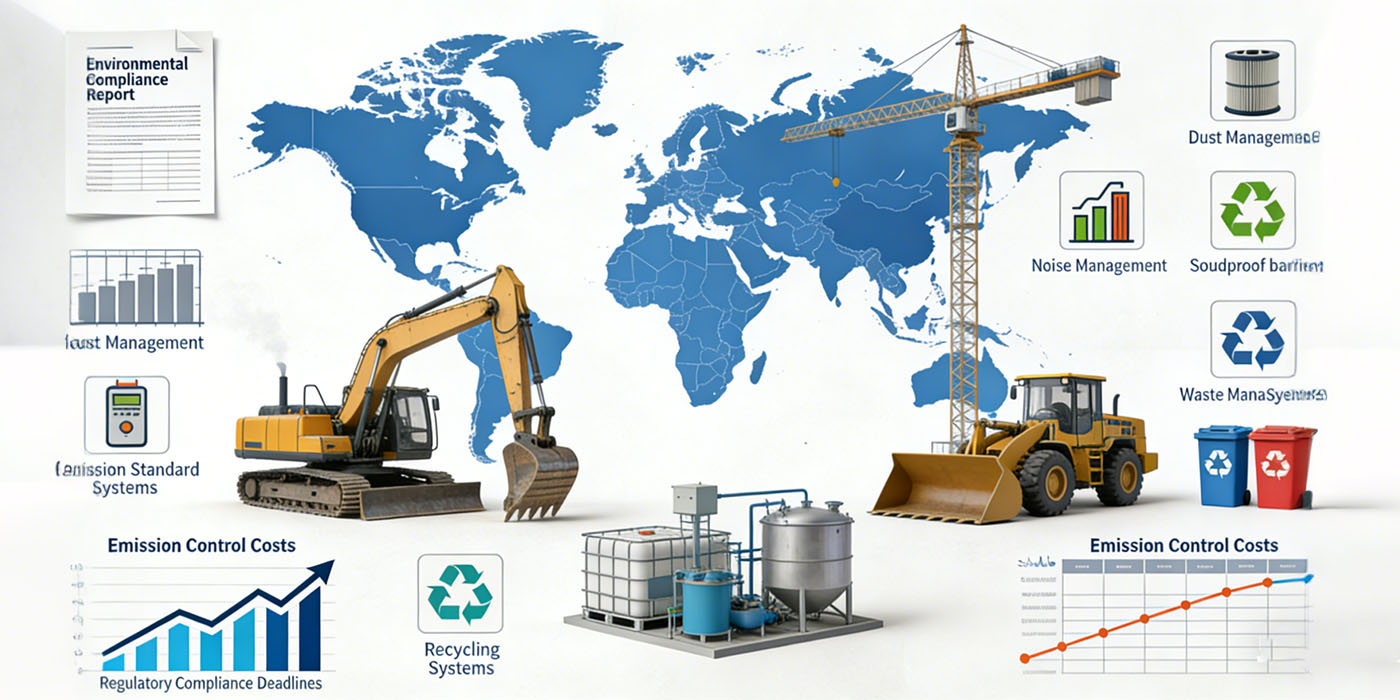
Emission Standards and Equipment Restrictions
Different countries impose strict emission requirements on construction machinery, especially Non-Road Mobile Machinery (NRMM), including limits for nitrogen oxides (NOx), particulate matter (PM), and carbon dioxide (CO₂).
| Emission Standards and Equipment Restrictions | |||
|---|---|---|---|
| Country / Region | Applicable Equipment | Emission Standard | Impact & Application |
| EU | Excavators, rollers, batching plants | Stage V | PM < 0.025 g/kWh, strict NOx limits; low-emission equipment purchase or retrofitting required |
| USA | Bulldozers, cranes, pavers | EPA Tier 4 | NOx and PM strictly controlled; restrictions on older equipment in certain cities |
| China | Excavators, pavers, concrete pumps | China 6 / 6b | Heavy diesel machinery limited; encouragement to adopt new-energy equipment |
| Korea | Municipal construction machinery | Low-emission & fuel efficiency standards | Mandatory low-sulfur fuel; high-emission equipment operation restricted |
Application Impact:
- Contractors must prioritize purchasing or upgrading compliant equipment.
- Older diesel machinery needs retrofitting or replacement to avoid fines or work stoppage.
- Construction plans must balance emission restrictions with productivity.
Dust and Noise Control Requirements
Urban construction and densely populated areas make dust and noise major regulatory concerns.
| Dust and Noise Control Requirements | |||
|---|---|---|---|
| Control Item | Technical Measures | Quantitative Requirement | Application Scenario |
| Dust | Spraying, dust suppression, enclosed material transport | PM10 ≤ 50 μg/m³ (24h average) | Urban expressway construction, bridge reconstruction |
| Noise | Time-of-day restrictions, low-noise equipment | Daytime ≤ 70 dB(A), Night ≤ 55 dB(A) | Urban road construction, bridge lifting |
| Online Monitoring | Real-time dust and noise monitoring | Data uploaded to cloud platform | Smart site monitoring and scheduling |
Application Impact: High-density urban projects must use low-noise, low-dust equipment. Construction plans should optimize operation timing and equipment sequence based on monitoring data.
Water Use and Waste Management Regulations
Water consumption, wastewater discharge, and construction waste management are also key regulatory areas.
| Water Use and Waste Management Regulations | ||
|---|---|---|
| Region | Core Requirement | Technical Application |
| EU | Wastewater recovery and recycling | Wastewater treatment systems, material reuse |
| USA | River and wetland protection | Base impermeability, rainwater management, construction cofferdams |
| China | Water resource use permits | Recycling of concrete and asphalt materials, rainwater collection |
Application Impact:
- Contractors must design drainage and wastewater treatment plans to avoid violations.
- Material recycling is a core green construction method to improve resource efficiency.
- Environmental measures increasingly influence bid scoring, directly affecting project awards.
Development Directions of Green Construction Technologies
With global carbon reduction and resource recycling policies advancing, green construction technologies are increasingly becoming standard in road and bridge projects. By using low-carbon materials, recycled aggregates, energy-efficient equipment, and optimized construction processes, energy consumption and carbon emissions can be reduced while improving efficiency and project economics. This section analyzes three main green construction technology directions and their quantified benefits.

Warm Mix Asphalt (WMA) Technology
Warm Mix Asphalt reduces mixing temperatures to save energy and cut CO₂ emissions.
| Warm Mix Asphalt (WMA) Technology | |||
|---|---|---|---|
| Technical Indicator | Conventional Hot Mix Asphalt (HMA) | Warm Mix Asphalt (WMA) | Improvement Effect |
| Mixing Temperature | 160–180 ℃ | 110–140 ℃ | Energy reduction 20–30% |
| CO₂ Emission | 100% baseline | 75–85% | Emission reduction 15–25% |
| Workability Window | ±2 h | ±3 h | Construction flexibility +15% |
| Recycled Material Content | 20–30% | 30–50% | Material utilization +10–20% |
Application Scenarios: Highways, urban expressways, bridge decks.
Trend: WMA combined with recycled aggregates is expected to achieve over 60% adoption in major European and North American markets within 5 years.
Use of Recycled Pavement Materials
Recycled materials reduce natural resource consumption, waste disposal, and transport costs.
| Use of Recycled Pavement Materials | |||
|---|---|---|---|
| Material Type | Replacement Ratio | Application Scenario | Effect/Benefit |
| Reclaimed Asphalt Pavement (RAP) | 20–50% | Urban roads, highways | Saves 15–25% virgin asphalt, CO₂ reduction 10–15% |
| Recycled Concrete Aggregate | 30–60% | Subgrade fill, non-structural pavements | Reduces natural sand and gravel demand 20–30%, cost reduction 10–15% |
| Recycled Stabilized Soil | 40–70% | Low-grade roads, rural roads | CO₂ reduction 10–20%, improves material recycling |
Trend: Combined with WMA to achieve low-carbon and high recycling use. Standardization of recycled material quality and mix ratios will become a core metric in future green construction.
Energy-Efficient Construction Equipment
Energy-efficient equipment reduces fuel or electricity consumption, improves efficiency, and lowers carbon emissions.
| Energy-Efficient Construction Equipment | |||
|---|---|---|---|
| Equipment Type | Energy/Fuel Compared to Conventional | CO₂ Reduction | Application Example |
| Electric Vibratory Roller | -25–30% | -20–25% | Highway subgrade compaction |
| Electric Concrete Pump | -20% | -15% | Bridge and high-pier concrete pumping |
| Hybrid Paver | -15–25% | -10–20% | Urban expressway paving |
Trend: In 5–10 years, electric + intelligent construction equipment will become standard for green construction. Coupled with smart scheduling and construction data analysis, energy use and carbon emissions can be further optimized.
Impact of ESG Principles on Contractors
Environmental, Social, and Governance (ESG) principles are becoming key factors in decision-making for global road and bridge projects. Contractors integrating ESG principles into bidding, construction management, and long-term operations can not only improve project win rates and brand reputation but also reduce environmental and social risks. Green construction, community responsibility, and lifecycle maintenance have become new metrics for assessing contractor competitiveness.

Increased Environmental Weight in Project Evaluation
| Increased Environmental Weight in Project Evaluation | |||
|---|---|---|---|
| Region/Country | Environmental Weight in Bidding | Core Indicators | Application Example |
| European Union | 15–25% | Low-carbon material usage, energy consumption, smart construction | Cross-border highway project in France: Green construction scoring accounted for 20% of total points; winning contractor led in energy-efficient equipment and recycled material use |
| United States | 10–20% | Emission control, waste management | Urban expressway renovation in California: WMA and water recycling applied; environmental score improved by 15% |
| China | 10–15% | Green construction certification, carbon emission monitoring | Shenzhen highway project: Contractor achieved green construction certification, score improved 12% |
Application Impact:
ESG metrics directly affect bid evaluation and project award outcomes.
Low-carbon construction, recycled materials, and energy-efficient equipment provide scoring advantages.
Contractors must integrate ESG strategies at the project planning stage.
Community Impact and Social Responsibility Requirements
| Community Impact and Social Responsibility Requirements | |||
|---|---|---|---|
| Indicator | Requirement | Technology/Measures | Quantified Effect |
| Construction Noise | Limit in residential areas | Low-noise equipment, sound barriers | Noise reduction 15–25 dB(A) |
| Dust Emission | Control air quality | Spray dust suppression, enclosed transport | PM10 reduction 30–40% |
| Community Communication | Transparency and complaint handling | Smart construction management platform | Complaints reduced by 20% |
Application Example: Tokyo bridge renovation project: Noise barriers and spray dust suppression reduced community complaints by 40%, ensuring smooth project progress.
Extended Responsibility for Long-Term Operations and Maintenance
| Extended Responsibility for Long-Term Operations and Maintenance | |||
|---|---|---|---|
| Project Type | Extended Responsibility | Technology/Management Measures | Effect |
| Highways | Pavement durability and drainage | Recycled materials + WMA + smart monitoring | Pavement lifespan extended 15%, maintenance cost reduced 10% |
| Bridges | Girder and bearing monitoring | Structural health monitoring system | Early detection of potential cracks, maintenance cost reduced 20% |
| Urban Roads | Landscaping and drainage maintenance | Digital operation and maintenance platform | Community satisfaction improved 25% |
Application Impact: ESG principles extend beyond construction to full lifecycle management. Enhances brand reputation and social recognition, supporting future project competitiveness.
Project Organization Models and Construction Management Systems
As road and bridge projects grow in scale and complexity, effective project management has become a key competitive advantage. Efficient organizational structures, scientific delivery methods, and integrated management systems ensure quality, schedule, and cost control while reducing risk and enhancing international competitiveness. This chapter reviews the evolution of delivery models, challenges in multinational project management, and strategies for coordinated quality, safety, and schedule management.
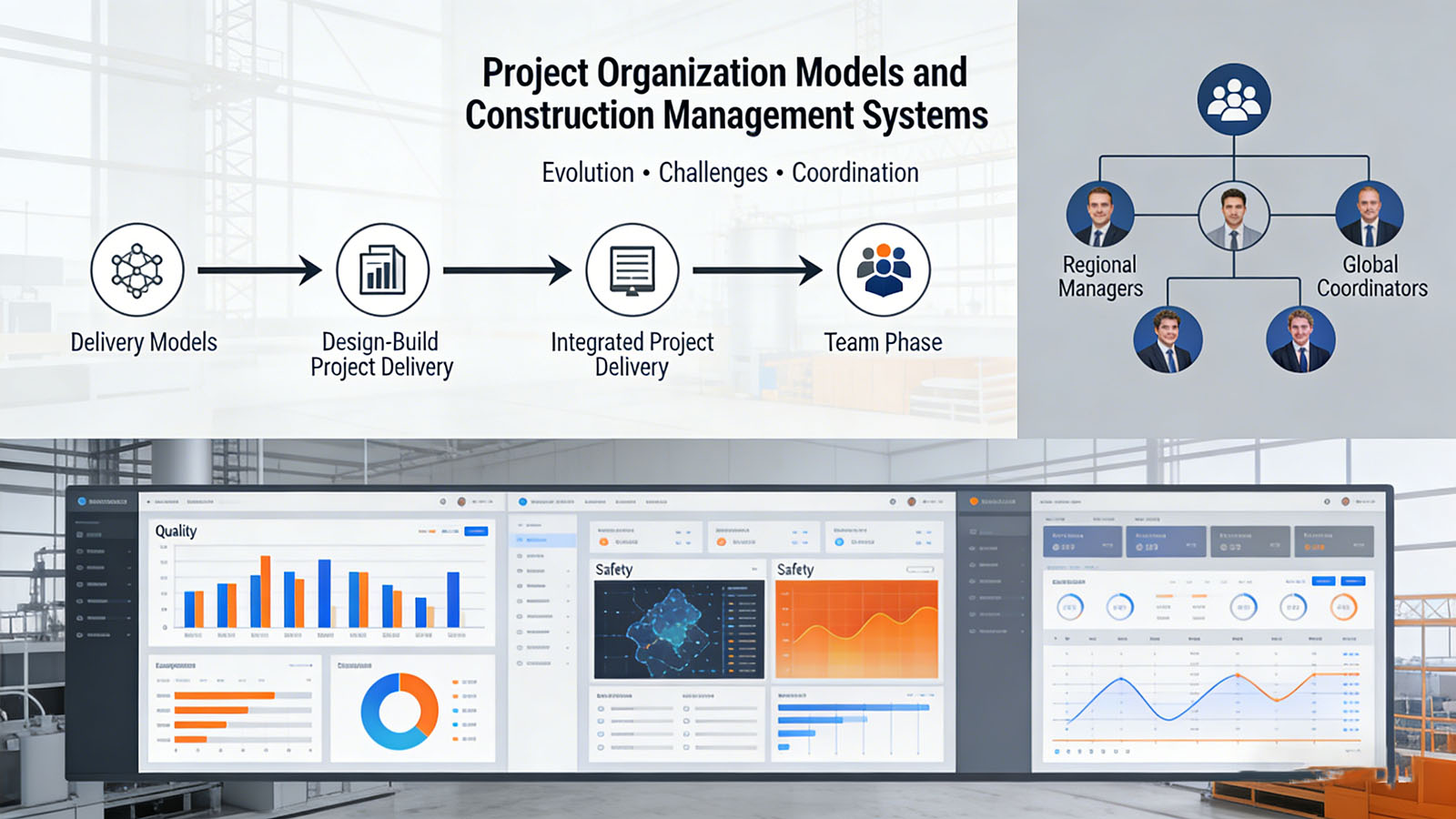

Evolution of Project Delivery Models
Project delivery models determine responsibility allocation across design, procurement, construction, and operation, affecting risk, cost, and schedule. Traditional Design-Bid-Build (DBB) is increasingly replaced by EPC turnkey and PPP/Concession models, allowing contractors to assume more risk while gaining higher integration and revenue potential. Key characteristics of each model are summarized below.
Traditional Design-Bid-Build (DBB) Model
EPC Turnkey Model (Engineering-Procurement-Construction)
| EPC Turnkey Model (Engineering-Procurement-Construction) | |||
|---|---|---|---|
| Project Feature | EPC Turnkey | Traditional DBB | Improvement Effect |
| Contract Structure | Single contract covering design, procurement, and construction | Separate contracts for design and construction | Collaboration efficiency increased 15–20% |
| Risk Allocation | Contractor assumes both design and construction risks | Design and construction risks shared between units | Risk centralized, requires professional management team |
| Schedule | Design and procurement can run concurrently | Strict linear sequence | Construction period reduced 10–15% |
| Cost Control | Overall budget controlled by contractor | Segmental budgets | Construction cost optimized 5–10% |
Application Scenarios: Highways, cross-sea bridges, complex urban expressways.
PPP / Concession Model (Public-Private Partnership / Concession)
Challenges in Managing Multinational Projects
As road and bridge projects expand globally, multinational project management faces multiple challenges, including regulatory differences, supply chain complexity, and local workforce issues. Variations in national standards, material transportation difficulties, and local labor skills and regulations significantly increase project management complexity. Efficient multinational management systems and digital tools are critical to ensuring smooth project execution.
Regulatory and Standards Differences
| Regulatory and Standards Differences | |||
|---|---|---|---|
| Region / Country | Standard Type | Management Challenges | Mitigation Measures |
| EU | Safety, environmental, labor | Lengthy approvals, strict environmental requirements | Establish dedicated compliance teams, review regulations in advance |
| USA | Design, drainage, flood control | Significant local regulation differences | Unified cross-regional standards + local engineering consultants |
| Middle East | High temperature, sandstorms | Construction permits and environmental constraints | Conduct early risk assessments, implement flexible construction plans |
| Southeast Asia | Material standards inconsistent | Difficult material certification, varying construction standards | Local material testing + comparison with international standards |
Impact: Regulatory differences may cause schedule delays of 5–15%. Early regulatory research and unified standard approaches can reduce delay risk by 10–12%.
Supply Chain Coordination
Local Workforce Management
| Local Workforce Management | |||
|---|---|---|---|
| Indicator | Challenge | Mitigation Measures | Quantified Target |
| Skill Level | Differences in language and construction skills | Local training + foreign technical guidance | Skill compliance ≥90% |
| Labor Regulations | Labor laws, working hours limits | Dedicated compliance management team | Regulatory violations 0% |
| Safety | Low safety awareness on-site | Monthly training + risk assessment | Incident rate ≤0.5% |
Case Study: A highway project in Saudi Arabia reduced construction accident rates by 35% through local training and multi-level communication mechanisms, ensuring smooth project progress.
Integrated Management of Quality, Safety, and Schedule
In large-scale road and bridge projects, quality, safety, and schedule are highly interdependent; any lapse in one aspect can impact the entire project. Modern construction management emphasizes systematic, digital, and quantifiable approaches. Using BIM, online monitoring, and intelligent scheduling, these three aspects can be optimized collaboratively, ensuring projects are completed on time, with high quality, and safely.
Quality Control System
| Quality Control System | |||
|---|---|---|---|
| Control Stage | Technical Measures | Quantified Indicators | Application Case |
| Materials | Incoming inspection, third-party testing | Pass rate ≥99% | German highway bridge project: material non-conformity <1% |
| Construction | Online monitoring, BIM model comparison | Deviation ≤5 mm | China Yangtze River Bridge: beam assembly deviation ≤4 mm |
| Acceptance | Multi-level inspection system | First-pass rate ≥95% | Singapore urban expressway: first-pass inspection rate 96% |
Impact: Online monitoring and BIM enable early detection of quality issues, reducing rework by 10–15%. Multi-level inspection ensures traceability and clear accountability throughout the construction process.
Safety Management
| Safety Management of Project Organization and Management | |||
|---|---|---|---|
| Safety Measures | Technical / Management Means | Indicator | Effect |
| Risk Assessment | Daily pre-operation checks | Injury rate ≤0.5% | Accident rate reduced by 20–30% |
| Equipment Safety | Regular maintenance and inspection | Equipment downtime ≤2% | Key equipment reliability improved |
| Training & Evaluation | Monthly staff training | Coverage 100% | Enhanced safety awareness, reduced accidents |
Application Case: A Saudi cross-border bridge project maintained an injury rate of 0.4% through equipment inspection and safety training, ensuring uninterrupted construction.
Schedule Compression and Risk Balancing
| Schedule Compression and Risk Balancing | |||
|---|---|---|---|
| Management Strategy | Technical Means | Quantified Effect | Application Case |
| Parallel Activities | BIM & construction simulation | Schedule shortened 10–15% | Tokyo urban expressway renovation project |
| Intelligent Scheduling | Construction scheduling software | Resource optimization +12% | India highway EPC project |
| Risk Mitigation | Critical milestone alerts, contingency plans | Delay probability reduced 15% | UAE urban bridge project |
Impact: Through process optimization, intelligent scheduling, and risk mitigation plans, schedule compression can be achieved without compromising quality or safety standards.
Investment and Financing Mechanisms and Industry Business Models
Road and bridge projects involve large investments, long timelines, and extended returns. Funding typically comes from government (40–70%), international financial institutions, and private infrastructure funds (6–9% IRR). Optimized financing reduces risks, improves efficiency, and supports innovation in construction and management. This chapter reviews key financing models, applications, and trends for contractors and investors.

Government Fiscal Investment Models
Government remains the main funding source for road and bridge construction, especially for public corridors and strategic infrastructure. Fiscal systems, budget allocations, and investment priorities vary by country, determining the division of central and local funding and the use of special funds and bond financing strategies.
Central vs. Local Fiscal Allocation
| Central vs. Local Fiscal Allocation | |||
|---|---|---|---|
| Country/Region | Central Budget Share | Local Budget Share | Application Notes |
| China | ~60% | ~40% | Central funds support highways and inter-provincial bridges; local governments fund auxiliary roads and supporting infrastructure |
| USA | 50–70% | 30–50% | Federal allocations cover interstate highways; state/city governments fund local roads |
| Indonesia | ~40% | 60% | National key corridors funded by central government; local authorities handle branch roads and rural roads |
Impact: Central funds ensure large strategic corridors are built on schedule. Local funding provides flexibility and supports regional infrastructure alignment.
Special Funds and Bond Financing
- Features: Governments establish dedicated funds or issue infrastructure bonds to raise long-term capital.
- Advantages: Eases annual budget pressure and secures long-term investment returns.
- Quantitative Examples: China “Local Government Special Bonds”: 2025 issuance ~ RMB 2.2 trillion for highways, bridges, and urban roads. EU Infrastructure Bonds: Total financing ~EUR 18 billion for green bridges and road network upgrades.
Participation of International Financial Institutions
The World Bank, Asian Development Bank, African Development Bank, and similar institutions provide low-cost long-term loans, technical support, and risk mitigation for cross-border or regional road and bridge projects, serving as key financing sources for large-scale projects.
World Bank and Regional Development Banks
| World Bank and Regional Development Banks | |||
|---|---|---|---|
| Institution | Main Financing Form | 2025 Financing Scale | Typical Projects |
| World Bank | Low-interest loans, technical assistance | ~$20 billion globally | African cross-border highways, South Asian bridges |
| Asian Development Bank | Loans + PPP advisory | ~$15 billion | India highway expansions, Southeast Asia inter-island bridges |
| African Development Bank | Loans + guarantees | ~$4 billion | Strategic bridges and highways in Sub-Saharan Africa |
Impact: Provides low-cost, long-term capital, reducing contractor financing pressure. Supports risk sharing for multinational projects, enhancing feasibility.
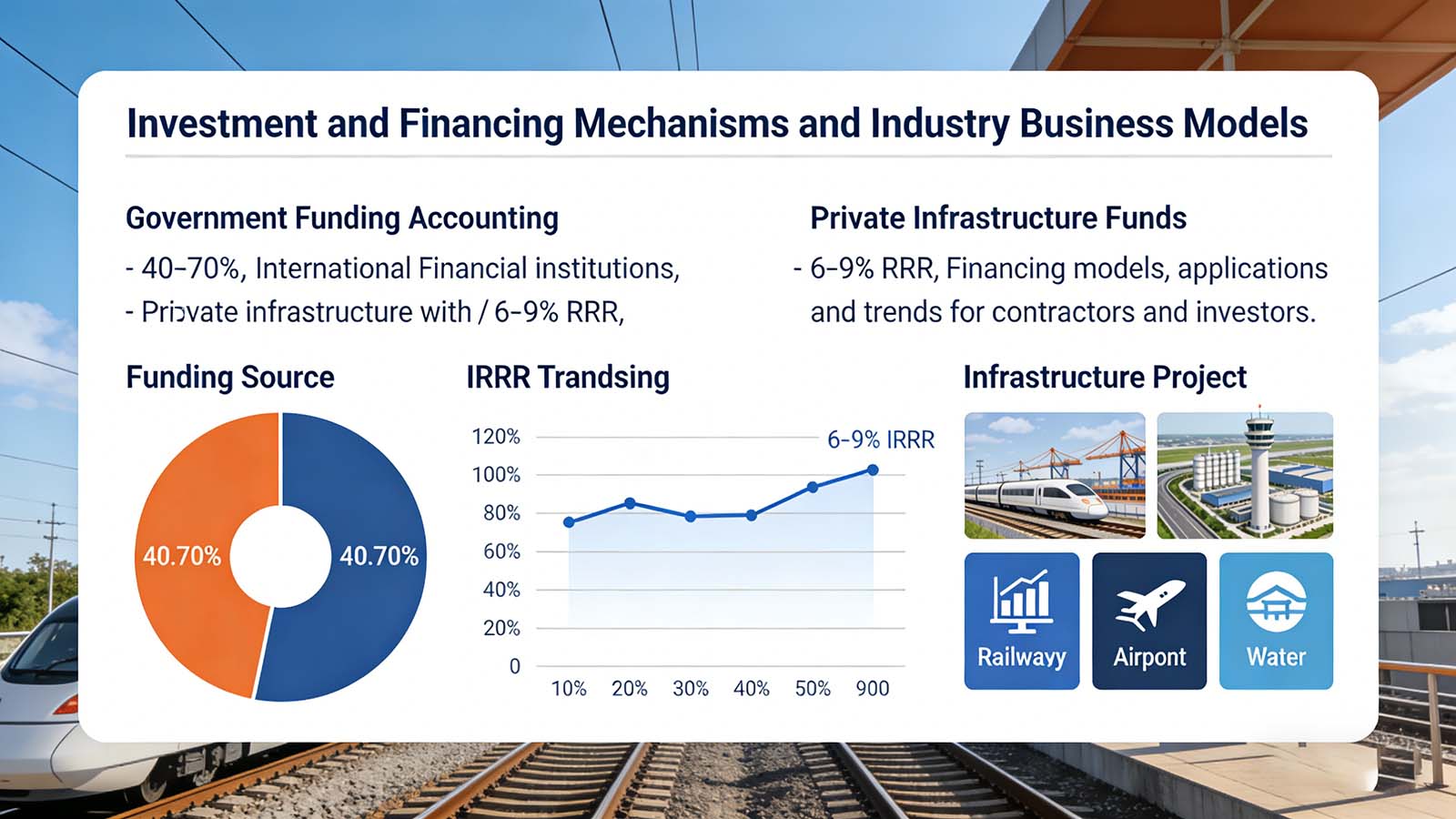
Project Financing Structure
Features: Project Finance relies on future cash flows, with risk and return shared among contractors, investors, and governments.
Key Points:
Diversified funding sources: loans, equity, government grants.
Risk isolation: project assets independent; non-recourse loans.
Financial transparency: strict cash flow monitoring and staged repayment schedules.
Application Case: Indonesian inter-island highway bridge project: $1.2 billion financing through multilateral bank loans + private capital. Risk-sharing mechanisms effectively controlled delays and cost overruns.
Private Capital and Infrastructure Funds
Private capital plays an increasingly important role in global road and bridge construction, especially in PPP projects and long-term revenue-generating assets. Infrastructure funds provide professional management, stable long-term returns, and promote innovation in construction technology and management.
Long-Term Revenue Asset Allocation Logic
Risk-Sharing Mechanism Design
| Risk-Sharing Mechanism Design | |||
|---|---|---|---|
| Risk Type | Responsible Party | Mitigation Measures | Quantitative Target |
| Construction Risk | Contractor | EPC turnkey + engineering insurance | Budget overrun ≤5% |
| Operation Risk | Private investor | Toll model + service level agreements | Revenue volatility ≤10% |
| Policy Risk | Government | Tax incentives, minimum revenue guarantees | Investment payback within ±1 year |
Application Case: Latin American highway PPP project: government provides minimum revenue guarantees; private funds manage toll system to achieve planned payback period.
Key Industry Players and Competitive Landscape
The global road and bridge construction industry features both highly concentrated multinational groups and regionally fragmented local contractors and subcontractors. Each type of player has distinct advantages in technology, construction efficiency, equipment resources, and market network. Understanding the industry structure supports strategic project planning, investment decisions, and supply chain management.
Global Major Engineering Contractors
Large engineering contractors dominate the global road and bridge sector, leveraging technology, capital, and project management capabilities for cross-border and large-scale projects. The market exhibits a “dual-track” pattern: international groups undertake complex, high-risk projects globally, while regional leaders dominate local markets with policy support and construction efficiency. Understanding these players helps evaluate market concentration, competitive barriers, and collaboration models.
International Engineering Groups
| International Engineering Groups | ||||
|---|---|---|---|---|
| Company | Headquarters | 2025 Revenue (USD bn) | Main Project Types | Global Market Share |
| Vinci | France | 61 | Highways, bridges, tunnels | 8–10% |
| China Communications Construction (CCCC) | China | 58 | Ports, bridges, international highways | 7–9% |
| ACS Group | Spain | 43 | Urban expressways, cross-sea bridges | 5–7% |
| Bouygues | France | 41 | Urban roads, bridges, tunnels | 4–6% |
| Bechtel | USA | 38 | Large EPC highways and bridges | 3–5% |
Key Features:
- Technology & Equipment: Large-scale bridge construction machinery, high-precision girder assembly, intelligent construction systems.
- Cross-border Experience: Expertise in international financing structures, PPP models, and multi-country regulations.
- Resource Integration: Ability to mobilize equipment and labor across regions for large projects.
Applications: CCCC built the Indonesia cross-island expressway (span 1,200 m), using precast girders and synchronized floating crane operations, achieving ±5 mm assembly accuracy. Vinci’s highway projects in France and Africa applied BIM and remote monitoring, reducing rework by ~12%.
Regional Leading Contractors
| Regional Leading Contractors | ||||
|---|---|---|---|---|
| Region | Company | 2025 Revenue (USD bn) | Main Market | Core Advantages |
| Southeast Asia | PT Wijaya Karya (Indonesia) | 1.2 | Domestic highways, urban roads | Strong government ties, high local construction efficiency |
| South Asia | Larsen & Toubro (India) | 1.5 | Highways and bridges | Strong engineering capability, PPP experience |
| Europe | Strabag (Austria/Central Europe) | 1.1 | Central European highways and urban bridges | Green construction and safety management expertise |
| Latin America | Odebrecht (Brazil) | 1.0 | Brazil and regional highways | Comprehensive construction and financial management skills |
Key Features:
- Policy Responsiveness: Quickly adapt to local approvals and budget changes.
- Cost & Efficiency Advantage: Localized supply chains and labor reduce construction costs.
- Collaboration Opportunities: Often partner with international groups on cross-border or PPP projects, combining technical and financial strengths.
Applications:
PT Wijaya Karya built a Javanese expressway using mobile asphalt plants and smart compaction equipment, improving efficiency by ~15%.
L&T in a South Asian PPP bridge project used risk-sharing mechanisms to reduce delays by 12%.
Local Construction Firms and Subcontracting Systems
Local construction firms play a foundational role in global road and bridge projects, handling core tasks such as civil works, earthworks, and base layers, while forming labor and specialized subcontracting systems. Their technical capability, management level, and resource integration directly affect construction efficiency, cost control, and quality assurance. Subcontracting models are flexible, but significant differences exist between firms, requiring project management and technical standards to ensure overall construction quality.
Labor and Specialized Subcontracting Models
| Labor and Specialized Subcontracting Models | ||||
|---|---|---|---|---|
| Subcontracting Type | Function | Advantages | Risks | Typical Application |
| Labor Subcontracting | Earth excavation, roadbed filling, base layer paving | Low cost, flexible scheduling | Limited skills, quality may fluctuate | Earthworks for Java Expressway, Indonesia |
| Specialized Subcontracting | Bridge girder prefabrication, lifting, asphalt paving | High technical capability, high efficiency | High cost, coordination complexity | Girder installation in L&T South India PPP bridge project |
| Integrated Subcontracting | Complete small-scale road and bridge construction | Improves project integration | Requires strong management | Mountainous expressway in Latin America |
Applications: Java Expressway, Indonesia: Labor subcontractors handled roadbed and base layer works, while specialized subcontractors prefabricated and installed bridge girders, improving overall construction progress by ~15%. South Asia PPP Bridge Project: Specialized subcontractors used BIM and smart compaction systems, achieving ±4 mm construction precision and reducing rework by 10%.
Technical Capability Differences
Local firms exhibit significant differences in technical capability, which can be classified into three levels:
| Technical Capability Differences | ||||
|---|---|---|---|---|
| Capability Level | Features | Construction Efficiency | Rework Rate | Application Example |
| High-tech Firms | BIM application, smart compaction, continuous paving | +5–10% | −10–15% | Indonesia and India PPP bridge projects |
| Medium-tech Firms | Partial mechanized construction | +2–5% | −5–10% | Urban road projects in Southeast Asia |
| Low-tech Firms | Mainly traditional manual construction | Baseline | High | Rural or underdeveloped area roads |
Analysis:
- High-tech firms significantly improve construction precision and efficiency while reducing material waste and rework costs.
- Medium- and low-tech firms offer cost advantages but are limited in large-span or complex bridge projects.
- Project management should strategically allocate labor and specialized subcontractors to ensure quality and schedule adherence.
Role of Equipment and Material Suppliers
Equipment and material suppliers play a critical supporting role in road and bridge construction. Their technical capability, service network, and supply capacity directly affect construction efficiency, quality, and project costs. Suppliers can be categorized into technology-driven suppliers and service-network-oriented suppliers. Modern large-scale projects increasingly rely on intelligent construction equipment and high-performance materials, while demanding faster after-sales response and localized support.
Technology-Driven Suppliers
| Technology-Driven Suppliers | ||||
|---|---|---|---|---|
| Supplier Type | Product/Service | Technical Features | Application Effect | Typical Project |
| Concrete Pumping Equipment | High-performance pumps | Automatic batching, remote monitoring | +15–20% concrete construction efficiency | Indonesia Cross-Island Expressway Bridge |
| Asphalt Pavers | Intelligent paving machines | Electronic control of paving thickness | +10–12% road surface smoothness | Urban expressway renovation, India |
| Bridge Lifting Equipment | High-capacity cranes | Precision positioning, remote operation | Girder installation accuracy ±3 mm | Yangtze River Bridge, China |
| Roadbed Compaction Equipment | Intelligent vibratory rollers | Automatic compaction thickness control | +8–10% compaction uniformity | Malaysia Expressway Project |
Analysis: Technology-driven suppliers leverage automation and intelligence to reduce labor dependence and improve precision and efficiency. In complex or large bridge projects, equipment performance directly determines construction schedule and quality.
Service Network Competitiveness
| Service Network Competitiveness | |||
|---|---|---|---|
| Service Capability | Indicator | Application Effect | Typical Project |
| Local Warehousing | Key spare parts inventory ≥90% | Equipment downtime reduced by 8–12% | Indonesia EPC Expressway Project |
| After-Sales Response | Equipment failure response ≤24h | Average equipment availability ≥97% | Southeast Asia Cross-Island Bridge Construction |
| Technical Support | On-site guidance ≥2 times/week | Reduced construction errors | Large urban bridge renovation, China |
Analysis: Suppliers with robust service networks ensure continuous operation of critical equipment, minimizing schedule risks. Localized warehousing and technical support are essential for smooth execution of cross-regional construction projects.
Road and Bridge Construction Industry Risks and Challenges
The global road and bridge construction industry faces multiple risk factors that directly impact project costs, schedules, and investment returns. Macro-economic fluctuations, raw material price volatility, policy changes, and climate change can all lead to delays or cost overruns. Systematic identification, quantitative assessment, and risk management strategies are essential for maintaining project reliability and corporate profitability.

Macroeconomic and Fiscal Volatility Risks
Economic cycles directly affect government infrastructure spending and private capital participation. Fiscal tightening or economic downturns can delay or cancel projects, particularly impacting large-scale road and bridge projects.
| Macroeconomic and Fiscal Volatility Risks | ||||
|---|---|---|---|---|
| Risk Type | Manifestation | Quantitative Indicator | Mitigation Measures | Application Example |
| Economic Recession | Reduced government investment | Infrastructure budget down 5–15% | Adjust project pace, prioritize core corridors | Highway upgrades in parts of Europe delayed |
| Exchange Rate Fluctuation | Increased international contract costs | Foreign currency costs account for 20–30% of total | Hedging instruments, foreign currency contracts | Indonesia Cross-Border Bridge PPP project |
Raw Material Price and Supply Chain Instability
Road and bridge construction relies on cement, asphalt, steel, and other critical materials. Global supply chain tensions or price fluctuations can increase construction costs and cause material shortages.
| Raw Material Price and Supply Chain Instability | ||||
|---|---|---|---|---|
| Material | Price Fluctuation (2025–2026) | Impact | Mitigation Measures | Application Example |
| Cement | +6–9% | Project total cost +2–4% | Early price-lock contracts, inventory management | Yangtze River Bridge, China |
| Asphalt | +8–12% | Pavement cost increase | Warm Mix Asphalt (WMA), recycled material use | Urban expressway upgrade, Indonesia |
| Steel | +5–10% | Bridge girder cost increase | Supplier diversification, long-term contracts | Mountain highway bridge, Brazil |
Policy Changes and Compliance Risks
Road and bridge construction is subject to environmental, land, tax, and safety regulations. Policy changes or approval delays can extend schedules, raise costs, or even halt projects.
| Policy Changes and Compliance Risks | ||||
|---|---|---|---|---|
| Policy Type | Risk Manifestation | Potential Impact | Mitigation Strategy | Application Example |
| Environmental Regulations | Emissions, noise limits | Shortened construction windows | Green construction technologies, low-carbon equipment | Urban road projects, Europe |
| Land Policy | Delays in demolition/expropriation | Schedule delays 3–6 months | Early planning, government coordination | Expressway project, Indonesia |
| Tax/Duties | Restricted material imports | Cost increase 1–3% | Optimize procurement, alternative materials | Highway bridge project, Latin America |
Construction Uncertainty Due to Climate Change
Global climate change causes frequent extreme weather events, including floods, heatwaves, heavy rainfall, and strong winds, posing major challenges to schedules, material performance, and construction safety.
| Construction Uncertainty Due to Climate Change | ||||
|---|---|---|---|---|
| Climate Factor | Impact | Quantitative Indicator | Mitigation Measures | Application Example |
| Heavy Rain/Flooding | Roadbed softening, delayed construction | Schedule delay 5–15% | Optimize drainage, adjust construction season | Tropical expressways, Southeast Asia |
| High Temperature | Asphalt aging, concrete cracking | Construction window reduced 20–30% | Warm Mix Asphalt, water spraying | Urban expressways |
| Strong Winds/Typhoons | Lifting and bridge construction affected | Safety stoppage 1–2 days per event | Risk warning system, adjust work sequence | Coastal bridge construction |
Technological Evolution and Future Construction Trends
As global road and bridge projects grow in scale and complexity, technological innovation is profoundly transforming construction methods, organizational structures, and project management models. Intelligent equipment, prefabricated construction, industrialized building, low-carbon materials, and data-driven decision-making have become core industry trends. Technology upgrades not only improve efficiency and quality but also optimize resource allocation, reduce costs and carbon emissions, and lay the foundation for the next 5–10 years of industry development.


Prefabricated and Industrialized Construction Trends
Prefabricated and industrialized construction leverages precast components, modular assembly, and factory production to significantly enhance efficiency and quality, especially for long-span bridges, high piers, and urban expressways. Compared with traditional in-situ construction, prefabrication can shorten schedules by 20–40%, reduce material waste by 10–15%, and minimize environmental impacts on-site.
| Prefabricated and Industrialized Construction Trends | |||
|---|---|---|---|
| Technology Type | Application Scope | Benefits | Typical Projects |
| Precast Girders | Long-span bridges, urban viaducts | Schedule shortened 25%, rework reduced 12% | Yangtze River Bridge, China; |
| Modular Pavement Panels | Urban expressways, airport runways | Construction cycle shortened 30%, material loss reduced 10% | Kuala Lumpur Urban Expressway, Malaysia |
| Factory-Produced Components | Bridge piers, foundations, railings | Precision ±3 mm, reduced on-site operational risks | Indonesia PPP Cross-Island Expressway |
Smart Construction Sites and Data-Driven Decision-Making
Smart construction sites utilize BIM, IoT, drones, and construction sensors to enable digital, visualized, and real-time management. Data-driven decision-making enhances workflow coordination, construction quality, and safety, particularly in large and complex projects.
| Smart Construction Sites and Data-Driven Decision-Making | |||
|---|---|---|---|
| Technology | Function | Application Effect | Typical Projects |
| BIM Modeling | Design coordination, clash detection | Early detection of design conflicts reduced by 40% | Urban highway renovation, China |
| Construction Sensors | Real-time monitoring of concrete and subgrade compaction | Construction precision ±5 mm | Cross-Island Expressway, Indonesia |
| Drone Inspection | Bridge and pavement quality monitoring | Inspection efficiency improved 5–10× | Mountain highway bridges |
Analysis:
Data-driven management reduces construction errors and rework.
Smart sites improve multi-process coordination and schedule control, increasing efficiency of large cross-regional projects by 10–15%.
Low-Carbon Materials and New Structural Systems
Global carbon reduction pressures are driving the adoption of low-carbon materials and innovative structural systems. Warm-mix asphalt, recycled concrete, high-performance reinforcement, and new bridge structures are emerging trends. Low-carbon materials reduce environmental impact while enhancing durability and construction efficiency.
| Low-Carbon Materials and New Structural Systems | |||
|---|---|---|---|
| Material/Structure | Application | Benefits | Typical Projects |
| Warm-Mix Asphalt | Road surfaces, urban expressways | Energy saving 30%, emissions reduced 20% | Mumbai Urban Expressway |
| Recycled Concrete | Subgrade and base layers | Material cost reduced 15%, carbon emissions reduced 25% | European highway renovation |
| High-Performance Reinforcement | Bridge girders, foundations | Strength increased 15–20%, service life extended 25% | Yangtze River Bridge, China |
| New Bridge Structures | Cable-stayed bridges, suspension bridges | Construction period shortened 15–20%, safety factor improved | Tokyo Bay Cross-Sea Bridge |
Analysis:
- Low-carbon materials are now a core competitive factor in project bidding.
- Innovative structural systems combined with prefabrication shorten schedules, reduce on-site risk, and optimize material efficiency.
- Over the next 5–10 years, green materials and advanced structures are expected to become standardized in global road and bridge construction.
Regional Development Opportunities and Key Investment Directions
With changes in the global economic landscape and accelerating urbanization, future growth in the road and bridge construction industry will concentrate on specific regions and project types. Key investment hotspots include transnational transport corridors, urban renewal and road upgrades, and infrastructure “gap-filling” projects in rural and underdeveloped areas. Identifying regional opportunities and prioritizing project types is essential for strategic planning and investment decision-making.

Opportunities in Transnational Transport Corridors
Transnational transport corridors are central to regional connectivity and international logistics hubs. Projects such as Asia’s Belt and Road Initiative, Africa’s cross-border highways, and Latin America’s Pan-American highway upgrades demand high efficiency, standardization, and cross-border management capabilities from major contractors and multinational equipment suppliers.
| Opportunities in Transnational Transport Corridors | |||||
|---|---|---|---|---|---|
| Region | Project Type | Investment Scale (USD billion) | Main Challenges | Mitigation Strategy | Typical Projects |
| Asia | Cross-border highways and bridges | 50–200 | Complex terrain, cross-border approvals | Modular construction, PPP financing | China-Laos China-Laos Railway Expressway Bridges |
| Africa | Cross-border trunk roads, highway hubs | 30–120 | Weak infrastructure, material transport | International contracting + local partnerships | Kenya-Uganda Cross-Border Expressway |
| Latin America | Pan-American highway upgrades | 20–100 | Mountain and rainforest construction, fiscal instability | Multilateral financing, phased construction | Brazil North-South Highway Connectivity Project |
Urban Renewal and Road Upgrade Market
Accelerated urbanization and aging road networks drive demand for urban road reconstruction, expressway expansion, and bridge rehabilitation. Contractors’ competitiveness relies on smart traffic management, green construction, and high-density construction capabilities.
| Urban Renewal and Road Upgrade Market | |||||
|---|---|---|---|---|---|
| Market Type | Investment Focus | Annual Investment (USD billion) | Core Requirements | Mitigation Measures | Typical Projects |
| Urban Expressways | Expansion, reinforcement, interchanges | 15–40 | High efficiency, construction safety, minimal traffic impact | Night-time construction, modular pavement panels | Kuala Lumpur Urban Expressway Upgrade, Malaysia |
| Aging Bridges | Strengthening, demolition & reconstruction | 5–15 | High precision, minimal disruption | Precast girders, BIM monitoring | Tokyo Bridge Renewal Project, Japan |
| Road Intelligence | Smart streetlights, intelligent signage | 1–5 | Data management, traffic flow optimization | Smart site management systems | Shanghai Urban Road Renewal, China |
Gap-Filling Projects in Rural and Underdeveloped Areas
In rural and underdeveloped regions, insufficient transport infrastructure limits regional economic development and logistics efficiency. Projects prioritize low-cost, highly adaptable, and rapid construction solutions.
| Gap-Filling Projects in Rural and Underdeveloped Areas | |||||
|---|---|---|---|---|---|
| Region | Project Type | Investment Scale (USD billion) | Core Challenges | Mitigation Measures | Typical Projects |
| Rural Asia | Village roads, township expressways | 1–5 | Complex terrain, limited funding | Small-scale construction equipment, modular solutions | Rural Roads in Java, Indonesia |
| Rural Africa | Trunk roads | 2–8 | Material transport difficulties, seasonal restrictions | Mobile equipment, rapid subgrade treatment | Central Kenya Rural Roads |
| Remote Latin America | Village roads and bridges | 1–6 | Mountainous and rainforest terrain | Lightweight bridge modules, recycled materials | Mountain Road Gap-Filling Projects, Peru |
Build the Future: Smart, Green, and Connected Infrastructure
The global road and bridge industry is entering a transformative era. Urbanization, cross-regional logistics, low-carbon policies, and digital construction drive efficiency and sustainability. In the next 5–10 years, growth will focus on high-potential regions and strategic projects. Governments, contractors, suppliers, and investors must collaborate—innovate, optimize, and green the sector—to deliver lasting economic, social, and environmental impact.
