


Concrete batching plant for sale is not just about acquiring equipment—it’s about ensuring consistent concrete quality, reliable supply, and efficient production. For construction companies, project developers, and businesses with concrete production needs, the right batching plant can boost profitability, accelerate project timelines, and reduce reliance on external suppliers. Choosing the right plant is key to achieving long-term operational efficiency and cost savings.

Types of Concrete Batching Plants for Sale: Which One Fits Your Project?
When searching for a concrete batching plant for sale, understanding the available types is critical. Each type has unique features, advantages, and ideal applications. Choosing the wrong type can lead to inefficiencies, higher costs, and production delays. Here’s a detailed breakdown of the main plant types:
Stationary Batching Plant for Sale – For Continuous Large-Scale Concrete Production
Stationary batching plants are built for large-scale, continuous concrete production, delivering stable quality and high output for demanding construction projects. As shown in the table below, AIMIX’s popular models—AJ-90, AJ-120, and AJ-180—offer different capacities and configurations, allowing users to choose the most suitable stationary batching plant to efficiently meet their project requirements.
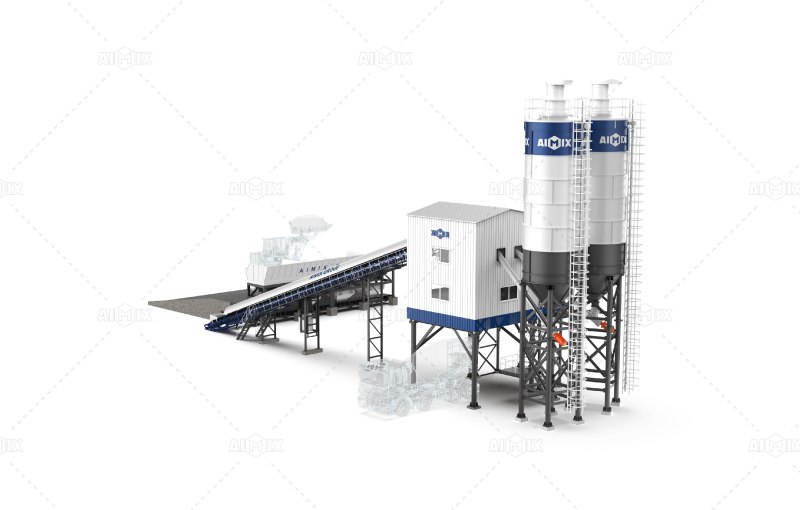


| Key Items | AJ-90 | AJ-120 | AJ-180 |
|---|---|---|---|
| Theoretical Production Capacity | 90 m³/h | 120 m³/h | 180 m³/h |
| Suitable Projects | Medium or relatively large projects, long-term fixed operations (e.g., road and bridge projects, industrial parks, high-rise building clusters) (1–3 years or longer, average concrete demand is relatively low) | Large projects, long-term fixed operations (e.g., road and bridge projects, industrial parks, high-rise building clusters) (1–3 years or longer, average concrete demand is moderate) | Extra-large projects, large-scale production (e.g., cross-sea bridges, new urban development), commercial concrete bulk supply (1–5 years or longer, large volume) |
| Footprint | Large (~600–800 m²), requires dedicated hardened site, simple material yard, partial lab may be needed | Large (~700–900 m²), requires dedicated hardened site, simple material yard, lab required | Extra-large (~800–1000 m²), requires dedicated hardened site, material yard, and lab |
| Installation & Relocation | 20–30 days, overall poured foundation, fixed (foundation can be omitted) | 25–40 days, overall poured foundation, fixed (foundation can be omitted) | 30–45 days, complex foundation, permanently fixed (foundation can be omitted) |
| Core Configuration | Twin-shaft mixer (1.5 m³), 2–4 cement silos (100–150T), 4-bay batching machine, separate weighing | Twin-shaft mixer (2.0 m³), 2–4 cement silos (150–200T), 4-bay batching machine, separate weighing | Twin-shaft mixer (3 m³), 2–4 cement silos (150–300T), 4-bay batching machine, separate weighing |
| Power & Energy Consumption | Total power 170–200 kW, energy-efficient | Total power 200–250 kW, energy-efficient | Total power 250–320 kW, large-scale energy advantage |
| Recommended Maximum Concrete Grade | C60 | C60 | C60 |
| Production Flexibility | Medium-low (focus on batch production) | Medium-high (focus on batch production, multiple cement silos for frequent grade changes) | High (mainly large batch single grade, multiple silos for frequent grade changes) |
| Environmental & Automation Level | Standard environmental protection (pulse dust removal + sound insulation), intelligent control | High-efficiency environmental protection (pulse dust removal + insulated enclosure), intelligent control | Advanced environmental protection (fully enclosed material yard + desulfurization dust removal), IoT + intelligent scheduling |
| Required Operators | 6–8 (1 central control + 2 batching + 2 maintenance + 1–2 dispatch) | 6–8 (1 central control + 2 batching + 2 maintenance + 1–2 dispatch) | 12–15 (2 central control + 3 batching + 3 maintenance + 2 dispatch + 2–3 environmental/logistics) |
| Matched Mixer Trucks | 8–10 trucks (12–16 m³/truck, improves transport efficiency) | 10–15 trucks (12–16 m³/truck, improves transport efficiency) | 15–20 trucks (12–18 m³/truck, with intelligent dispatch system) |
| Loader Quantity & Size | 50 loaders / 1 unit | 50 loaders / 1 unit | 50 loaders / 1 unit |
| Coverage Radius | 20–30 km (suitable for large project coverage) | 20–30 km (suitable for large project coverage) | 30–50 km (supports cross-region supply, requires mixer truck insulation and admixture system) |
Mobile Concrete Batch Plant for Sale – Fast Setup and Easy Relocation
The mobile concrete batching plant is a highly integrated, and easily transportable solution, designed for quick deployment, flexible operation, and reliable concrete production at temporary or remote sites. Aimix popular mobile concrete plant models are AJY-60 and AJY-90.


Features and Advantages:
Highly Integrated & Modular DesignCore components—mixer, batching system, belt conveyor—are mounted on a single mobile chassis with modular structure. Quick installation in 1–3 days without complex foundations.
Excellent MobilityTire-based chassis allows trailer towing on roads and unpaved sites, solving the fixed plant’s immobility issue.
Flexible ApplicationPerfect for small to medium projects such as rural roads, bridges, housing, or emergency repairs, adapting easily to changing site needs.
Automated & Easy OperationIntelligent control system automates batching, weighing, mixing, and discharging with high accuracy, reducing labor and enabling quick startup.
Low Site RequirementsCan operate on flat ground (≤3° slope) without concrete foundations. Compact layout (300–500 ㎡) suits temporary or remote sites.
Environmentally Friendly & SafeEquipped with dust collection devices and safety features (guardrails, emergency stop buttons), ensuring compliance and operator safety; modular design allows easy maintenance and cost-effective operation.
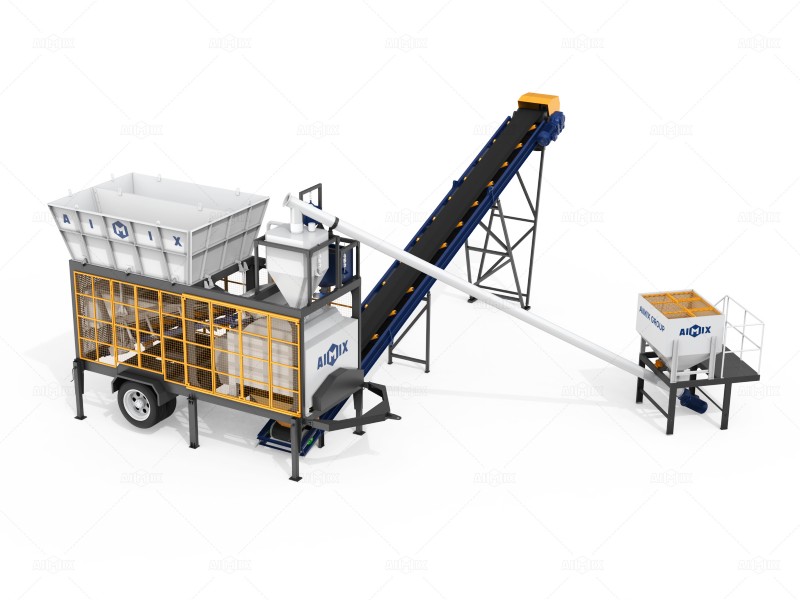
AJSY40 Compact Concrete Plant for Sale
- Applicable Projects: Ideal for small-scale, temporary, short-term construction, such as rural roads and small buildings (1–6 months).
- Footprint & Installation: Requires 150–200㎡, can operate without hardened foundation, installable within 24–48 hours.
- Core Configuration: Twin-shaft mixer (1 m³), simple ton-bag cement silo (≈2 m³) or cement silo (50–100 T), embedded batching, belt weighing system.
- Production Capacity: Maximum concrete grade C30, flexible for small batches or multiple grades quickly.
- Operation & Environmental Features: Basic environmental protection (no dust collector), semi-automatic control, requires only 2–3 operators (1 operator + 1–2 batching/assistants).
- Transportation & Support: Supports 2–3 mixer trucks (8–12 m³) and 1 loader (30 T), 5–10 km transport radius to avoid concrete segregation.
Eco-Friendly Batch Plant for Sale – Sustainable Solution for Green Building
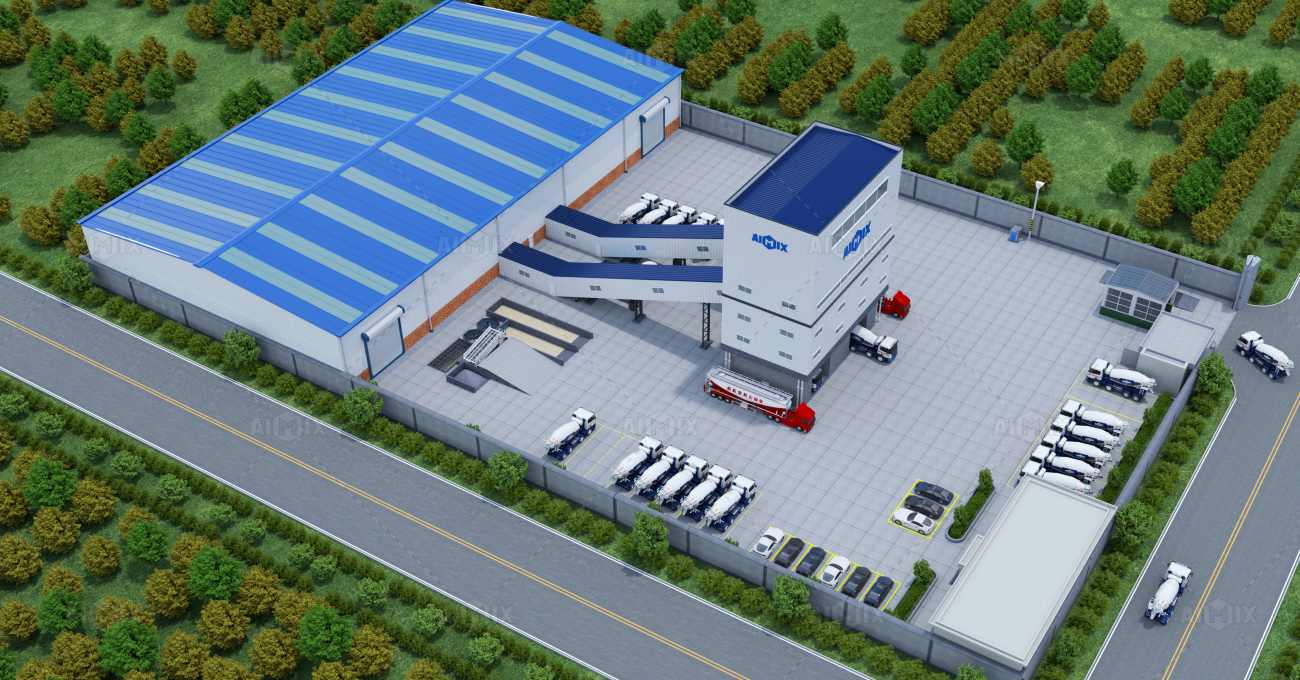
An environmentally friendly concrete batching plant is designed to reduce pollution, conserve resources, and promote sustainable construction. It features dust collection systems, closed-loop water recycling, energy-efficient motors, and noise reduction measures. These plants minimize emissions and waste while maintaining high production efficiency. Aimix provides eco-friendly batching plant solutions with production capacity ranging from 180 to 300m³/h to suit all your requirements.
Concrete Batching Solutions Powering Diverse Projects
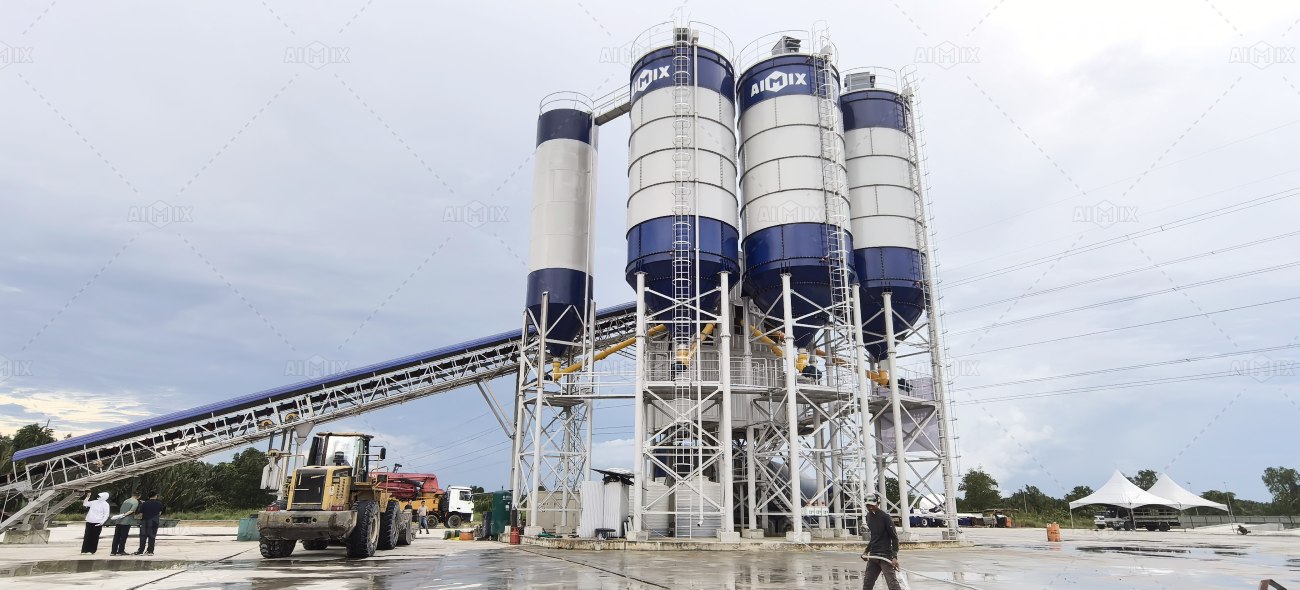
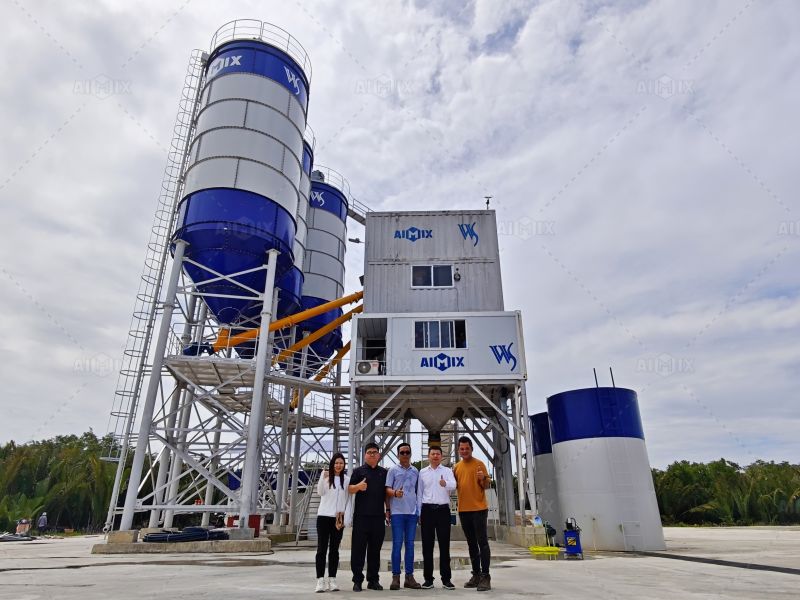
AJ-180 Concrete Plant Sale for Commercial RMC Operations in Malaysia
Customer’s Requirements
A commercial construction company in Malaysia needed a high-capacity ready mix concrete plant to ensure faster batching cycles and consistently high-quality concrete, particularly during peak construction periods.
Our Solution
- We supplied an AJ-180 stationary batching plant equipped with a 3 m³ Sicoma twin-shaft mixer.
- Its high batching efficiency and precise material dosing ensure reliable and consistent concrete output.
- The robust plant design minimizes downtime and reduces overall maintenance requirements.
Outcome & Value
- The large-capacity batching plant successfully met peak-season production demand.
- It delivered consistent concrete quality across multiple commercial projects.
- This project serves as a model demonstrating Aimix’s capability in large-scale RMC plant manufacturing.
Concrete Plant Site Tour
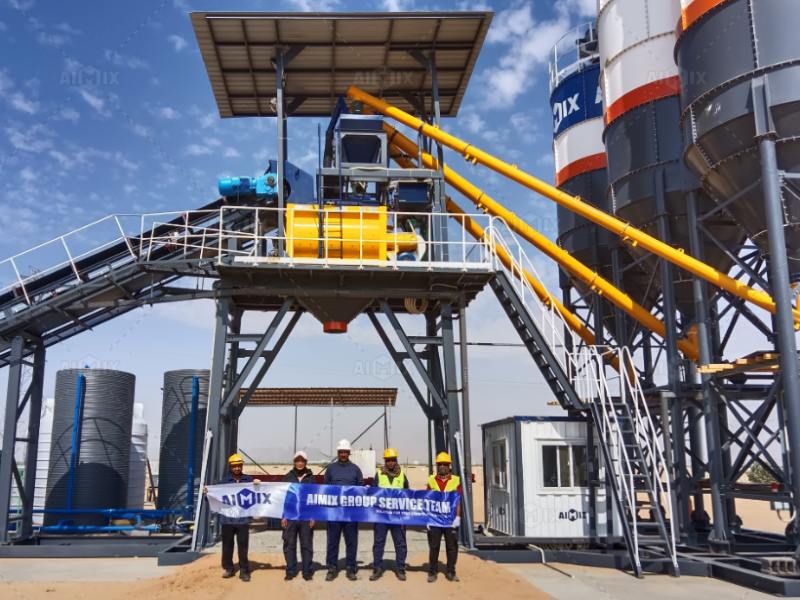
AJY-75 Mobile Batching Plant for Government Construction Projects in Ethiopia
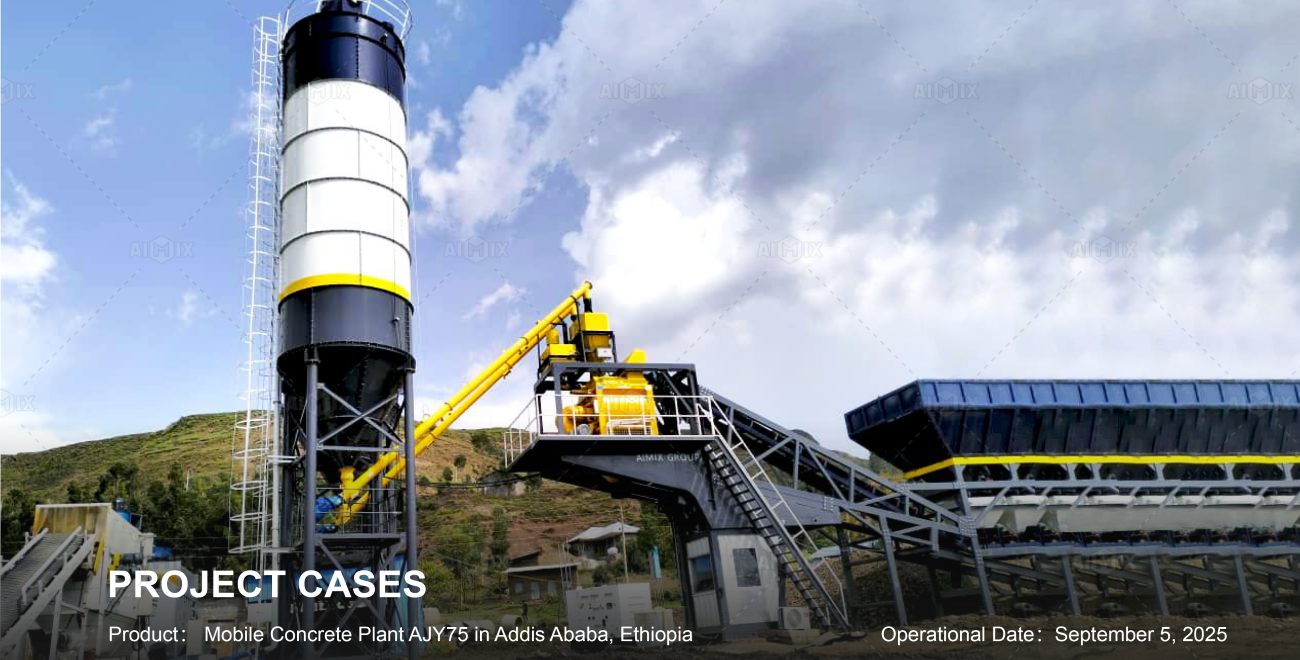
Customer’s Requirements
The client needed a mobile concrete plant that met strict government standards while remaining flexible, cost-effective, and easy to relocate, ensuring efficient operations across multiple project sites.
Our Solution
- We supplied an AJY-75 mobile concrete batching plant with a JS1500 mixer, ensuring fast setup and reliable, high-quality concrete production.
- Its compact modular design allows easy relocation and flexible use across multiple job sites.
- The automated batching system guarantees precise mix control and compliance with strict project requirements.
Outcome & Value
- The solution fully met government project requirements for both concrete quality and production efficiency.
- It delivered a cost-effective operation with reliable performance and minimal downtime throughout the project.
- This project highlights Aimix’s expertise in mobile plant solutions for public-sector and regulatory-driven applications.
Customer’s Feedback
“The mobile plant met all our standards and was easy to operate. Aimix’s rapid and professional support ensured smooth project execution.”
AJ-60 Concrete Batch Plant Supporting Concrete Production Upgrade in Laos

Customer’s Requirements
A leading mining company in Laos sought a reliable, medium-capacity concrete plant to replace aging equipment, enhance batching efficiency, and support the growth of its expanding operations.
Our Solution
- We supplied an AJ60 stationary batching plant with a customized layout tailored to the client’s site conditions.
- Its robust design ensures stable operation, consistent concrete quality, and low maintenance requirements.
- We also provided pre-sales consultation, on-site installation, and operator training to ensure a smooth project handover.
Outcome & Value
- Production efficiency improved significantly, enabling the project to meet all demands without delays.
- Maintenance costs were reduced thanks to modern components and a durable plant design.
- The batching plant achieved smooth operation and ensured long-term operational reliability.
Customer’s Feedback
“The batching plant is easy to manage, and AIMIX’s support is nice and professional. We are confident in this long-term partnership.”
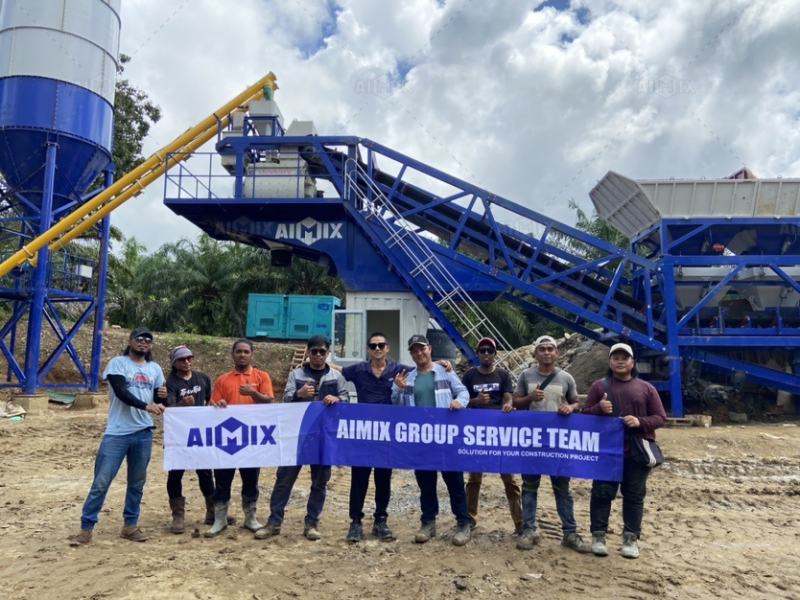
AJSY-35 Compact Concrete Batching Plant for Roadbed Paving in Malaysia

Customer’s Requirements
The Kuala Lumpur client required a compact mobile batching plant for fast setup, reliable concrete quality, and efficient operation under tight schedules.
Our Solution
AIMIX recommended the AJSY35 mobile compact concrete plant for sale and provided:
- Compact, Trailer-mounted Design: Easy to move between dispersed work zones.
- Fast Installation: No heavy civil foundation required, ready for production in 10 days.
- Customized Configuration: Tailored to the customer’s specific material requirements.
- On-site Support: Installation, commissioning, and operator training for smooth operations.
Outcome & Value
- The project achieved a stable and quality concrete supply throughout its duration.
- Labor and installation costs were reduced, accelerating overall progress.
- The plant’s flexible mobility enabled efficient operation across multiple construction zones.
Customer’s Feedback
The project manager praised the plant’s efficiency, reliability, and quick deployment, expressing satisfaction and plans to purchase additional mini batching plants for future infrastructure projects in Malaysia.
Concrete Batching Plant for Sale: Built for Reliability and Low Maintenance
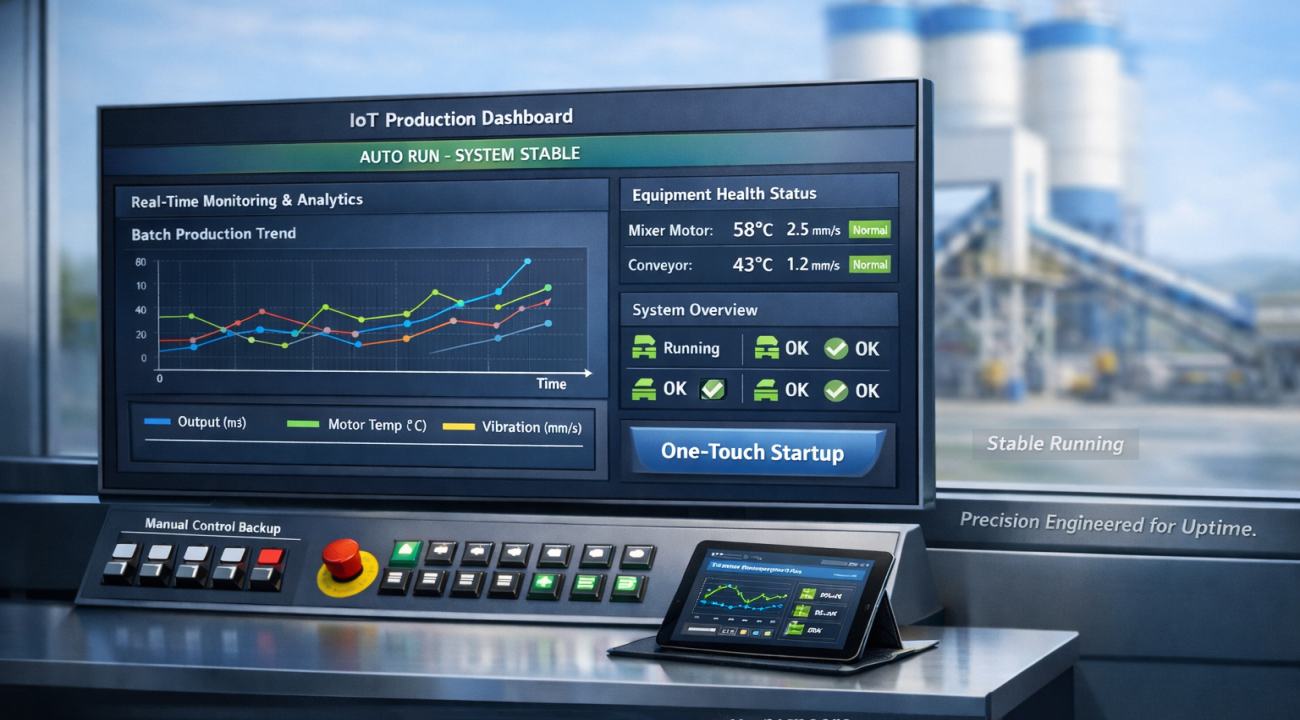
For any project investing in a concrete batching plant for sale, dependable performance and minimal maintenance play a decisive role in keeping production steady and costs under control. Equipment with frequent breakdowns, complex operation, or high maintenance demands can lead to downtime, material waste, and rising operating expenses. Aimix batching plants are therefore designed with smarter control systems and durable components to ensure long-term, trouble-free operation.
Integrated Control Systems Ensure Stable Operation and Fewer Breakdowns
Advanced integrated control systems play a critical role in improving plant reliability while lowering maintenance requirements.
- Dual Operation Modes: Support both PLC touchscreen control and physical buttons, ensuring stable operation even if one interface is unavailable.
- Reduced Human Error: Automation reduces operator-related mistakes by up to 50%, significantly lowering the risk of batching errors and abnormal shutdowns.
- Faster Startup: One-touch startup shortens preparation time by over 30%, reducing idle operation and mechanical stress.
- Simplified Processes: Automated workflows limit manual intervention, resulting in smoother production cycles and reduced wear on key components.
By stabilizing daily operations, these systems help prevent unnecessary equipment strain and maintenance issues.
IoT Remote Monitoring Enhances Equipment Reliability
IoT-based remote monitoring transforms maintenance from reactive to preventive, greatly improving plant reliability.
- Real-Time Data Tracking: Continuously monitors motor temperature, vibration, current, and other critical parameters.
- Lower Failure Rates: Early anomaly detection reduces unexpected failures by up to 40%.
- Extended Equipment Lifespan: Continuous condition monitoring helps prolong machine service life by more than 15%.
- Reduced Maintenance Costs: Timely diagnostics cut maintenance expenses by approximately 25%.
- Automated Alerts: The system generates diagnostic reports and instant alerts, allowing technicians to address issues before serious damage occurs.
This capability is especially valuable for overseas or remote projects where on-site technical support may be limited.
Predictive Maintenance Minimizes Unexpected Shutdowns
Predictive maintenance is a core reason why modern concrete batching plants require significantly less manual upkeep.
- Data-Driven Maintenance Scheduling: Maintenance plans are based on actual runtime hours and component wear data.
- Prevention of Sudden Failures: Early service notifications help avoid unexpected breakdowns and costly emergency repairs.
- Extended Component Life: Timely maintenance reduces excessive wear, extending the lifespan of critical parts.
- Continuous Production: Fewer interruptions mean projects stay on schedule and production remains stable.
This proactive approach ensures long-term reliability while reducing overall maintenance workload.
Precision Feeding Systems Reduce Wear and Material Waste
Precision feeding systems not only improve production accuracy but also contribute to lower maintenance demands.
- Stable Material Flow: Optimized feeding improves production continuity and increases effective uptime by 20%.
- Reduced Material Waste: Precise control minimizes raw material loss by approximately 10%, lowering operational costs.
- Remote Adjustment: Feed speed and ratios can be adjusted remotely via mobile devices, reducing manual intervention.
- Automatic Calibration and Alerts: Self-calibration and low-level alerts prevent feeding interruptions and equipment stress.
By maintaining consistent material flow, these systems reduce mechanical impact and help protect core components from premature wear.
How to Choose the Right Concrete Mixing Plant for Your Project
 |
 |
 |
|---|
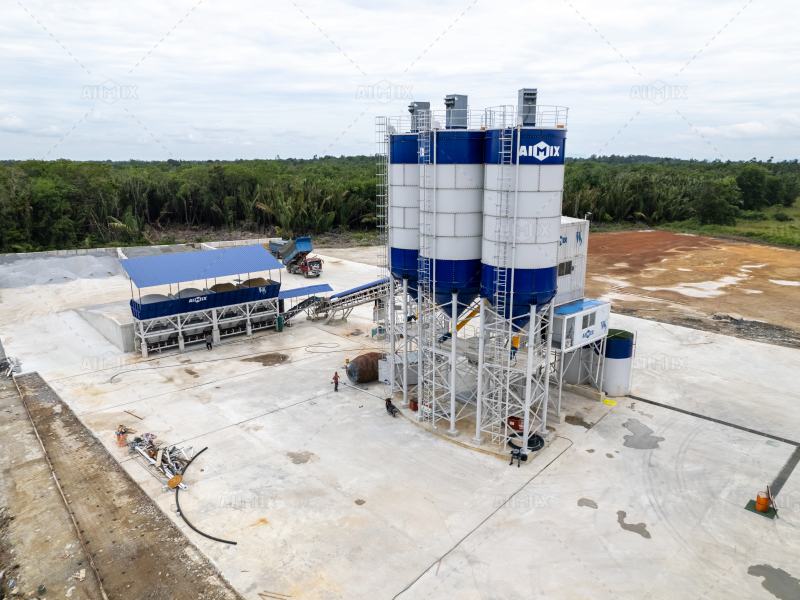
Whether you’re working on residential buildings or large-scale infrastructure projects, carefully considering the following key factors will help you make a smarter investment decision.
Assess Production Capacity Needs
Estimate your average daily and hourly concrete requirements.
Small to medium-scale projects (like residential or commercial buildings) usually require batching plants with capacities ranging from 25 to 90 m³/h.
Large infrastructure projects (highways, dams, ports) need higher-capacity plants, typically 120-180 m³/h and more.
Selecting a capacity that matches actual demand helps avoid production bottlenecks while preventing unnecessary investment in oversized equipment.
Mobility: Stationary vs. Mobile Concrete Mixing Plants
Choose stationary concrete mixing plants for long-term projects at fixed locations where continuous, high-volume production is required.
For projects that involve frequent relocation or temporary job sites, mobile concrete plants are a more practical option. They are designed for fast installation, easy transportation, and efficient use of limited space, making them ideal for flexible construction schedules.
Mixer Type and Output Quality
The type of mixer affects both production capacity and concrete quality:
Twin-shaft mixer: Provides high output, ideal for large-scale projects and demanding working conditions. Best suited for ready-mix concrete, high-strength concrete, and standard structural concrete.
Planetary mixer: Produces highly uniform concrete, perfect for fine aggregates and precise applications. Best suited for flowable concrete, self-compacting concrete (SCC), and architectural concrete requiring smooth finishes.
Automation and Control Technology
Modern batching plants integrate advanced systems such as PLC touchscreen controls and IoT-based remote monitoring to enhance productivity, minimize human error, and enable real-time maintenance tracking.
Site Conditions and Space Constraints
For urban or confined sites, compact or mini batching plants offer easy installation, mobility, and efficient use of limited space.
For large, permanent projects, stationary concrete plants like Aimix AJ-120 provide higher capacity, stable operation, and enduring reliability, ensuring smooth workflow and consistent concrete production.
Budget vs. Long-Term Operating Costs
Consider both upfront costs and ongoing expenses:
While more expensive upfront, advanced batching plants improve efficiency, reduce costs, and offer ongoing ROI.
Basic models are cheaper upfront but require more manual work and supervision, often increasing operational inefficiencies over time.
Investing slightly more in a modern plant usually ensures higher efficiency, lower running costs, and consistent concrete quality.
Regulatory Compliance and Certification
Is Now a Strategic Time to Invest in a Batching Plant for Sale?
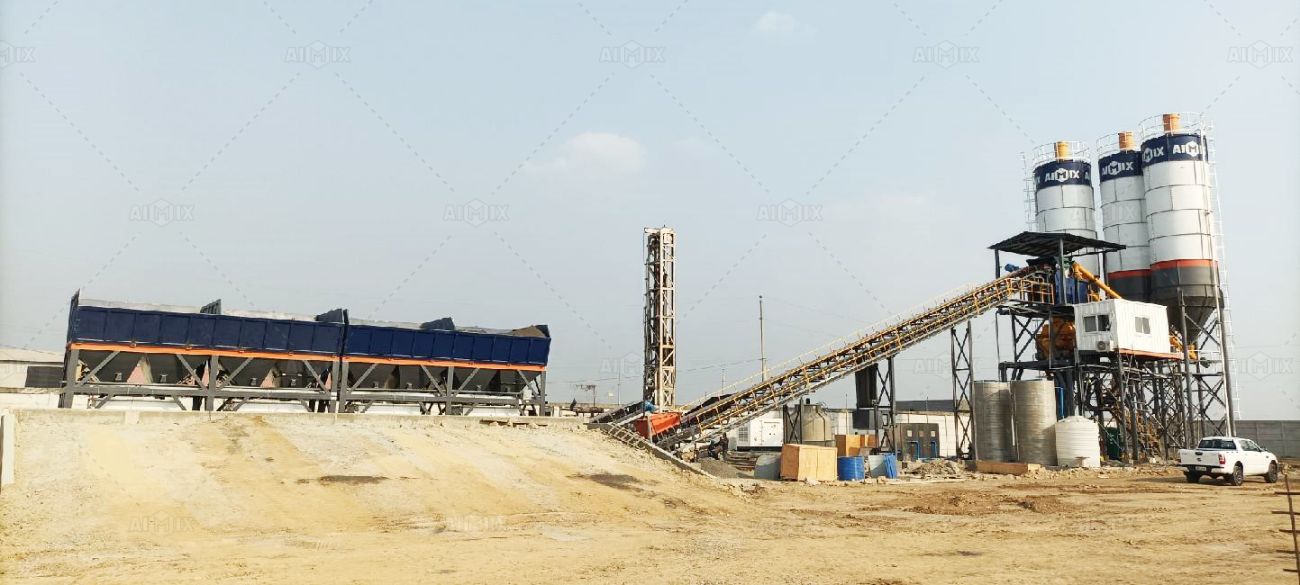
The construction industry is experiencing unprecedented growth worldwide, driven by large-scale infrastructure projects, urbanization, and housing demands. For contractors and developers, now presents a strategic opportunity to invest in a batching plant for sale and secure a competitive advantage in both efficiency and profitability.
Rising Demand for Ready-Mix Concrete
Global infrastructure and urban development are fueling consistent demand for high-quality concrete. Owning a batching plant ensures a reliable supply for internal projects while offering the option to supply external clients. This dual benefit can significantly increase revenue streams and reduce dependency on third-party suppliers.
Advanced Technology and Automation
Modern concrete batch plants come equipped with automated control systems, IoT monitoring, and precision batching technology. These features guarantee consistent quality, minimize human error, and improve efficiency. Investing now allows buyers to leverage the latest technology for sustained production reliability.
Cost Efficiency and Long-Term Returns
Purchasing a concrete batching plant reduces per-unit concrete costs and eliminates delivery uncertainties. Plants designed for scalability allow future expansion without major replacements, protecting your investment as project demands grow. Additionally, predictive maintenance and smart monitoring help lower downtime and maintenance costs.
Strategic Market Positioning
With growing competition in construction and concrete supply, owning a plant positions businesses as reliable and self-sufficient suppliers. Immediate investment allows companies to capture market opportunities, meet rising demand, and maintain durable operational stability.
Key Reasons to Select a Reliable Manufacturer for Your Concrete Plant Purchase
Buying a concrete plant is a significant investment, and selecting a reliable manufacturer is just as important as choosing the right equipment. A trusted manufacturer ensures smooth operations, project efficiency, and sustained value.
Quality Assurance and Compliance
Reputable manufacturers adhere to strict quality control processes and meet international standards such as ISO and CE certifications. This ensures the concrete plants are built with high-grade components, and tested for safety, durability, and performance. Choosing certified equipment gives you confidence that your plant complies with local regulations and consistently produces high-quality concrete.
Comprehensive After-Sales Support
Dependable suppliers provide end-to-end support that goes beyond installation. Our after-sales services mainly include:
- On-site Training: Reduces installation and commissioning difficulties, minimizes errors from inexperienced operators, and lowers maintenance costs.
- Equipment Installation: Options include online guidance, on-site service, or regional service outlets, saving recruitment and management costs while ensuring successful project delivery.
- 24-Hour Troubleshooting: Quick response to faults reduces downtime and prevents loss of productivity.
- Follow-Up Visits: Regular check-ins on equipment operation help improve efficiency, extend service life, and prevent safety risks.
These comprehensive services ensure your concrete batching plant runs efficiently, safely, and reliably over its lifespan.
Advanced Technology and Customization
Leading and reputable manufacturers integrate modern automation technologies such as PLC control, touchscreen panels, and IoT-enabled remote monitoring. These features boost productivity, reduce errors, and enable predictive maintenance. We offer efficient, intelligent, and flexible one-stop concrete batching solutions built for reliability and performance.
Proven Track Record and Customer Satisfaction
A reliable supplier will have a solid portfolio of successful projects and ongoing client relationships. Look for positive customer reviews, repeat buyers, and documented case studies.
Aimix is a strategic partner of Fortune Global 500 companies, reflecting our global reputation, product reliability, and professional service in the concrete equipment industry.
Partnering with a trusted concrete batching plant manufacturer ensures you’re investing in equipment that’s built to last—supported by expert service, advanced technology, and a proven commitment to your project’s success. Aimix is always ready to support your concrete business, offering expert guidance, reliable equipment, and comprehensive service.
Concrete Plants for Sale: Global Market Outlook & Forecast
Current Market Size & Growth Forecast
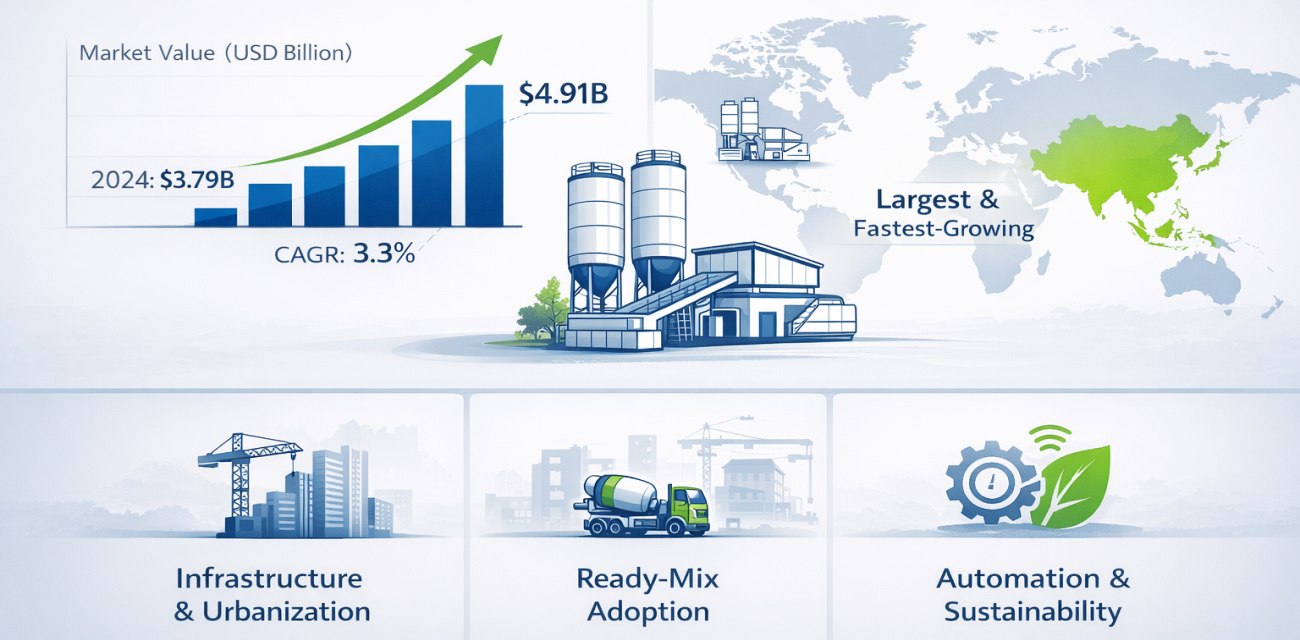
According to industry research, the overall concrete batch plants market was valued at around USD 3.79 billion in 2024 and is projected to reach approximately USD 4.91 billion by 2032, with a compound annual growth rate (CAGR) of about 3.3% through the forecast period. This growth reflects steady adoption of batching systems across residential, commercial, and infrastructure sectors worldwide.
Another report indicates that the broader concrete batching plant segment — including mobile and stationary units — could expand from roughly USD 2.77 billion in 2025 to over USD 4.4 billion by 2035 at a CAGR of around 4.7%.
Regional Market Dynamics
Asia‑Pacific remains the largest and fastest‑growing region for concrete plants, driven by major infrastructure projects and rapid urban growth in countries such as China, India, and Southeast Asia. This region often accounts for more than one‑third of global demand.
North America and Europe show steady expansion supported by infrastructure renewal programs, commercial construction, and sustainability initiatives. Meanwhile, Latin America, the Middle East, and Africa are emerging markets where mobile batching plants offer flexible solutions for remote or transitional project sites.
Key Market Drivers
- Infrastructure investment: Large‑scale public works and urban housing projects continue to drive demand for high‑capacity concrete production equipment.
- Ready‑mix concrete adoption: Companies increasingly prefer ready mix for quality consistency and delivery efficiency, supporting plant purchases.
- Technological advancements: Automation, IoT monitoring, and green features such as dust control and water recycling are enhancing plant performance and sustainability.
Emerging Trends
The market trend is shifting toward modular, mobile, and low‑maintenance batching plants for sale, which offer faster setup times, lower operational costs, and increased flexibility across project types. For investors and contractors alike, the outlook for concrete plants remains positive — now is an opportune time to consider high‑efficiency, future‑ready equipment that supports both current construction demand and evolving regulatory standards.
